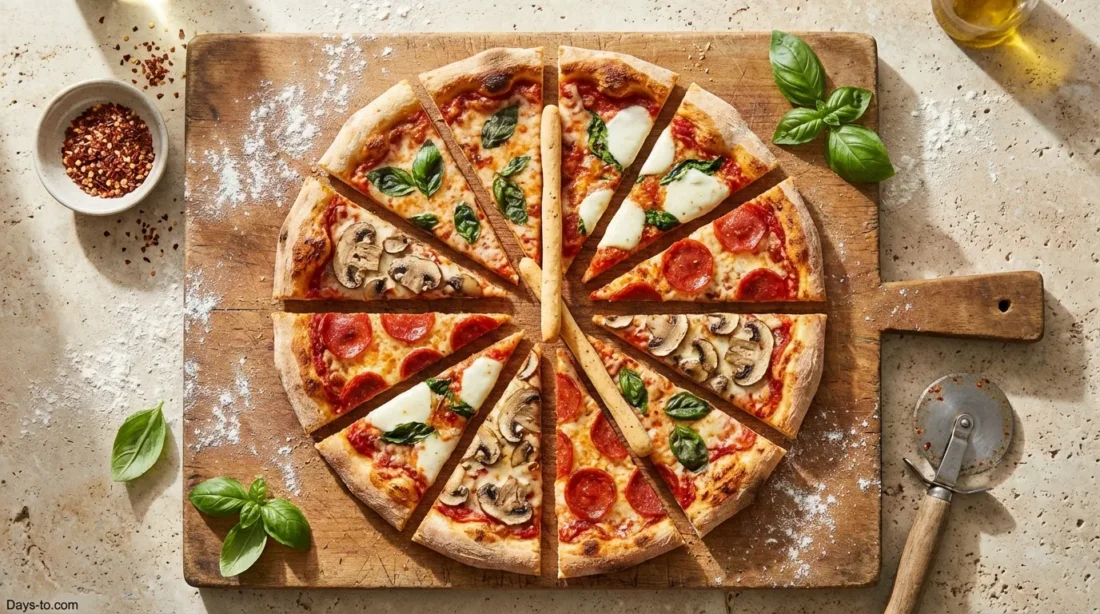
National Pizza Day
| Year | Day | Date | Days To |
|---|---|---|---|
| 2027 | Tue | February 9, 2027 | 105 days |
| 2028 | Wed | February 9, 2028 | 470 days |
| 2029 | Fri | February 9, 2029 | 836 days |
| 2030 | Sat | February 9, 2030 | 1201 days |
| 2031 | Sun | February 9, 2031 | 1566 days |
| 2032 | Mon | February 9, 2032 | 1931 days |
| 2033 | Wed | February 9, 2033 | 2297 days |
| 2034 | Thu | February 9, 2034 | 2662 days |
| 2035 | Fri | February 9, 2035 | 3027 days |
National Pizza Day falls on February 9 each year, and the date gives a familiar food its own place on the calendar. It is a food observance, not a public holiday, yet it has a clear identity: people mark the day by sharing pizza, talking about favorite styles, and revisiting the long story of a dish that moved from Naples to nearly every corner of daily life. Simple as the idea sounds, wide is its appeal. A single slice can carry history, craft, regional style, and the easy comfort of a meal meant to be enjoyed together.
Date and Basic Details
| Topic | Details |
|---|---|
| Date | February 9 every year |
| Type of observance | Annual food day |
| Main focus | Pizza as a shared meal, a craft food, and a lasting part of food culture |
| Most common setting | Homes, pizzerias, schools, offices, and casual gatherings |
| Best-known connection | Naples, where the modern form of pizza is strongly linked |
What National Pizza Day Marks
National Pizza Day marks the steady place of pizza in everyday eating. That is the real point of the day. It does not center on ceremony or formal tradition. Instead, it recognizes a food people already know well and return to often, whether they prefer a thin base, a folded slice, a pan pizza, or a soft Neapolitan pizza with a charred rim. The day feels accessible because pizza itself feels accessible: it works as a quick lunch, a family dinner, a late-night order, and a celebratory table centerpiece.
For many readers, the date matters in a very practical way. It answers a direct question: When is National Pizza Day? The answer is fixed and easy to remember. Every year, on February 9, the observance returns. Because the date does not move, it is useful for calendars, school food themes, restaurant planning, themed content, and annual reminders built around pizza history and pizza culture.
Why February 9 Is the Recognized Date
February 9 is the date most widely attached to National Pizza Day in annual observance calendars. Public references to the day agree on the timing, even though the observance is not usually explained through one single founding event. That makes it a little different from dates tied to a law, a memorial, or a named historical act. The date is established in practice. People recognize it, repeat it, and plan around it.
That everyday kind of recognition suits pizza rather well. Pizza did not become beloved because it was formal. It became beloved because it was satisfying, adaptable, and easy to share. So the date works almost like the food itself: plain on the surface, useful in many settings, and familiar enough that people do not need much explanation before joining in.
What the Date Does and Does Not Mean
- It does mark the yearly observance of National Pizza Day.
- It does not mark the invention date of pizza itself.
- It does give people one fixed day to highlight pizza styles, traditions, and social habits built around sharing food.
- It does not replace other pizza-related observances found later in the year.
How Pizza Reached This Place on the Calendar
Naples and the Classic Form
Modern pizza is closely tied to Naples, where flatbread traditions developed into the pizza people now recognize. In its classic Neapolitan form, pizza features dough, tomato, mozzarella, and basil in a combination that became famous far beyond Italy. A well-known example is the Margherita pizza, often linked to the late nineteenth century and still treated as one of the clearest expressions of pizza in its simplest, most balanced form.
Important too is the craft behind it. The work of the pizzaiuolo is not only about baking dough. It involves handling fermentation, stretch, heat, timing, texture, and the rhythm of oven work. Social it is as well. Pizza is prepared, served, discussed, and passed around. That is one reason pizza fits a yearly observance so naturally: the food carries both skill and shared experience.
From Local Dish to Daily Favorite
As Italian communities moved abroad, pizza moved with them. It changed shape as it traveled. Slices grew larger in some cities. Crusts became thicker in others. New toppings appeared, then stayed. That is how pizza became both a rooted food and a flexible one. You can point to Naples for the classic story, yet you can also point to New York, Chicago, Rome, Sicily, and many other places for styles that people now treat as fully their own.
That blend of tradition and adaptation helps explain why National Pizza Day draws attention so easily. Pizza is old enough to have history, and familiar enough to feel current. It is a food with roots, yet never stuck in one mold. That balance keeps it alive in homes, pizzerias, food writing, and annual date searches alike.
Well-Known Pizza Styles Often Mentioned on the Day
| Style | Main Features | Typical Eating Experience |
|---|---|---|
| Neapolitan | Soft dough, airy rim, light toppings, strong oven character | Balanced, tender, fast-baked, often served whole |
| New York-Style | Large slices, foldable crust, broad surface for toppings | Casual, portable, slice-friendly |
| Chicago Deep-Dish | High-sided crust, layered filling, hearty build | Rich, filling, eaten more like a plated meal |
| Roman | Often crisp and lighter in bite, with neat structure | Crunchier texture and clean slice |
| Sicilian | Thicker base, often rectangular, soft interior | Pan-baked feel with a substantial bite |
When people talk about pizza culture on February 9, they usually move quickly from the date to the styles. That shift makes sense. A food day is rarely only about a calendar square. It is also about memory, preference, and identity. One household may think first of thin crust. Another may picture a thick pan pizza with cheese pulled high from the slice. Neither reading is wrong. The day is wide enough to hold both.
Why People Enjoy the Day
- Pizza is easy to share.
- Styles vary without losing the core idea.
- It suits both home cooking and takeout.
- National Pizza Day is easy to remember.
What the Day Highlights
- Regional styles
- Dough and oven craft
- Pizza history
- Shared meals and familiar food traditions
What People Usually Do on National Pizza Day
Most observances of National Pizza Day stay simple. People order from a favorite local pizzeria. Families make dough at home. Schools and offices use the date for an easy themed lunch. Food writers compare slices, crusts, and toppings. Restaurants may highlight signature pies or classic combinations. Quiet it can be, or lively. Either way, the pattern is the same: the day turns attention toward a dish people already enjoy and gives them a reason to talk about it with a bit more care.
- Sharing a whole pie with family or friends
- Trying a different regional style
- Choosing a classic Margherita pizza to keep the focus on dough, sauce, and cheese
- Comparing homemade pizza with restaurant pizza
- Talking about crust texture, oven heat, and topping balance
The best part is how easy the day is to join. No special equipment is required for the idea itself. A slice is enough. Yet for people who love food history or kitchen craft, the same day can also open into deeper questions about fermentation, regional styles, old pizzerias, and the way a once-local food became part of ordinary life across generations.
National Pizza Day and Other Pizza Dates
Readers often mix up National Pizza Day with other pizza-themed observances. That is understandable. Pizza appears on more than one food-date list during the year. Some dates focus on cheese pizza. Some focus on pizza parties. Some are tied to a week rather than a single day. February 9 remains the clearest answer to the general question about National Pizza Day.
This distinction matters on informational pages. If a reader searches for the date of the broad pizza observance, the expected answer is the fixed February date, not a later themed variation. Put plainly, National Pizza Day = February 9. Other pizza dates may still be enjoyable and useful, but they serve narrower themes.
Pizza suits a calendar observance because it is easy to share, easy to adapt, and familiar across ages.
Why the Day Stays Popular
A food day lasts only if people keep finding themselves in it. Pizza does. It reaches children and adults, home cooks and restaurant regulars, people who love tradition and people who want new toppings every time. Familiar it is, but never flat. A classic pie can feel timeless. A regional version can feel tied to place. A homemade one can feel personal. All three can sit on the same table.
There is also a practical reason. Pizza works on an ordinary day. It does not need a long menu explanation or a formal setting to make sense. That makes National Pizza Day more durable than many novelty observances. The day survives because the meal already belongs to daily routines, family habits, and shared gatherings. The calendar simply gives it a name and a date.
Common Questions About National Pizza Day
Is National Pizza Day the Same Every Year?
Yes. National Pizza Day is observed on February 9 each year.
Is It a Public Holiday?
No. It is an annual food observance, not a government holiday.
Why Is Pizza Linked So Strongly to Naples?
Because the modern pizza story is closely associated with Naples, where the classic dough, tomato, and mozzarella style took recognizable form and where pizza craft became part of local food identity.
What Makes the Day Useful on an Informational Site?
It answers a clear date question while also opening into pizza history, regional styles, cultural meaning, and yearly search intent. The topic is fixed, repeatable, and easy for readers to revisit.
Do People Need to Follow a Formal Tradition?
No. The day is flexible by nature. Some people bake at home. Some order in. Some simply use the date to read about pizza, compare styles, or enjoy a favorite slice with others.