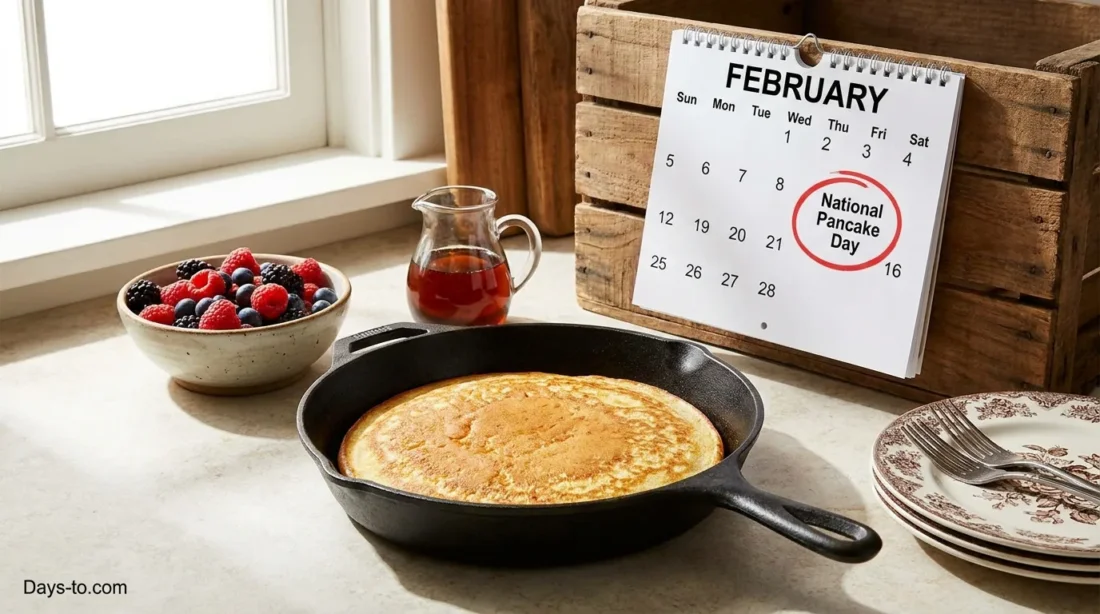
National Pancake Day
| Year | Day | Date | Days To |
|---|---|---|---|
| 2027 | Sun | September 26, 2027 | 342 days |
| 2028 | Tue | September 26, 2028 | 708 days |
| 2029 | Wed | September 26, 2029 | 1073 days |
| 2030 | Thu | September 26, 2030 | 1438 days |
| 2031 | Fri | September 26, 2031 | 1803 days |
| 2032 | Sun | September 26, 2032 | 2169 days |
| 2033 | Mon | September 26, 2033 | 2534 days |
| 2034 | Tue | September 26, 2034 | 2899 days |
| 2035 | Wed | September 26, 2035 | 3264 days |
National Pancake Day may sound like a simple food holiday, yet it carries more history than a plate of breakfast food first suggests. In the United States, National Pancake Day is most often linked with September 26, while other pancake celebrations follow different calendars. Some are tied to Shrove Tuesday, some to restaurant traditions, and some to local community events. The name is familiar, but the story has layers.
That is what makes the day worth explaining carefully. A pancake is not only a round cake cooked on a hot surface. It is a food shape found in many cultures, made with simple batter, shared at family tables, and used in seasonal customs. National Pancake Day turns that ordinary food into a calendar moment.
What National Pancake Day Means
National Pancake Day is a food observance that celebrates pancakes as a familiar, flexible, and widely loved dish. It is not a federal holiday. Schools, banks, and public offices do not close for it. Instead, it belongs to a lighter kind of calendar tradition: the type people mark through meals, social media posts, restaurant offers, family breakfasts, and small gatherings.
In the United States, the common calendar date is September 26. This version is separate from Pancake Day in the United Kingdom and several Commonwealth countries, where the name usually refers to Shrove Tuesday, the day before Ash Wednesday. Same food. Different date.
Date Names Can Be Confusing
The phrase National Pancake Day does not always point to one single celebration. In ordinary use, people may mean the September 26 food observance, a restaurant event, or Shrove Tuesday. For a history and date-based article, the safest explanation is simple: September 26 is the common U.S. food observance, while Shrove Tuesday changes every year.
Main Dates and Related Names
| Name | Usual Date | Main Meaning | Where It Is Commonly Used |
|---|---|---|---|
| National Pancake Day | September 26 | A U.S. food observance focused on pancakes as a popular dish | United States food calendar use |
| Pancake Day | Shrove Tuesday, date changes each year | A pre-Lent tradition linked with using rich ingredients before Ash Wednesday | United Kingdom, Ireland, and several Commonwealth countries |
| Shrove Tuesday | The day before Ash Wednesday | A Christian calendar day that also became tied to pancake meals in many homes | Western Christian calendar traditions |
| Restaurant Pancake Events | Varies by brand or year | Promotional events, often with free or discounted pancakes | Restaurant and community settings |
Why Pancakes Became Calendar Food
Pancakes fit calendar traditions because they are easy to make from basic ingredients. A simple batter can use flour, eggs, milk, water, salt, and a small amount of fat. That plain mixture becomes a meal in minutes. Simple food travels well through history, and pancakes did exactly that.
Long before modern food holidays, people cooked batter on hot stones, griddles, pans, and flat metal surfaces. The shape changed from place to place. Some pancakes were thin and soft. Some were thick. Some leaned sweet; others were savory. What stayed the same was the basic idea: a pourable mixture turned into a warm cake.
In parts of Europe, pancakes became linked with the day before Lent because they helped households use rich ingredients before a season of fasting and restraint. Eggs, milk, butter, and fat were too valuable to waste. So people cooked them. Practical first, festive later.
The September 26 Observance
The September 26 version of National Pancake Day is a modern food observance. It does not come from a government act or an old civic ceremony. Its tone is casual, warm, and community-friendly. People mark it by making pancakes at home, ordering them at breakfast restaurants, or sharing favorite versions online.
This date also shows how modern calendars work. Many food days are not official holidays in the legal sense. They survive because people enjoy them, repeat them, and attach small habits to them. National Pancake Day is easy to remember because the food needs little explanation. A stack on a plate says enough.
The day also gives room for many styles. Buttermilk pancakes, blueberry pancakes, cornmeal cakes, thin crêpe-like pancakes, oat pancakes, and small griddle cakes can all fit the theme. Not every pancake looks the same, and that is part of the charm.
Pancake Day and Shrove Tuesday
Pancake Day is a different calendar idea in many countries. It usually means Shrove Tuesday, the day before Ash Wednesday. Since Ash Wednesday depends on the date of Easter, Shrove Tuesday moves each year. It can fall in February or early March.
The word shrove comes from an older religious term connected with confession and preparation. Over time, the food custom became more visible in everyday culture. Many families now know the day mainly through pancakes, flipping traditions, toppings, and shared meals. The older meaning remains part of the date, but the kitchen memory is often what people notice first.
Here, the pancake had a useful role. It used ingredients that people might avoid or finish before Lent. Eggs, milk, butter, and sugar could all go into one pan. A religious calendar habit became a household food tradition. Quietly, through repetition.
September 26
National Pancake Day as a U.S. food observance is commonly marked on September 26. It is mainly about celebrating pancakes as a dish.
Shrove Tuesday
Pancake Day in many countries refers to Shrove Tuesday. Its date changes because it is tied to Easter.
How Pancakes Crossed Cultures
Pancakes appear in many food traditions because the method is direct. Grind grain, mix it with liquid, cook it on heat. That basic process can produce many foods: American pancakes, French crêpes, Russian blini, Ethiopian injera, Korean jeon, Indian dosa, Dutch pannenkoeken, and many more. Each has its own texture, ingredients, and serving style.
Some are breakfast foods. Some are street foods. Some appear at celebrations. Some hold fillings. Others carry sauces, fruit, cheese, herbs, lentils, or vegetables. The word pancake can feel narrow, but the family of foods is wide.
That range helps explain why a pancake day works as a public-friendly observance. People can join it without needing one exact recipe. A pancake can be personal. Thick, thin, sweet, plain, small, wide, crisp at the edge, soft in the center. All count.
Common Pancake Styles
| Style | Texture | Typical Ingredients | Common Serving Idea |
|---|---|---|---|
| American Pancake | Thick, soft, fluffy | Flour, eggs, milk, leavening, butter | Served in stacks with syrup or fruit |
| Crêpe | Very thin and flexible | Flour, eggs, milk, butter | Filled or folded with sweet or savory fillings |
| Blini | Small, tender, often slightly tangy | Wheat or buckwheat flour, dairy, yeast or leavening | Served with toppings or spreads |
| Dosa | Thin, crisp, and savory | Fermented rice and lentil batter | Served with chutney or vegetable filling |
| Pannenkoek | Wide and thinner than an American pancake | Flour, eggs, milk | Served sweet or savory |
Why the Day Became Easy to Share
Many calendar observances need explanation. National Pancake Day does not need much. The name gives people a clear action: make pancakes, eat pancakes, talk about pancakes. That direct link makes the day easy for homes, schools, cafés, restaurants, and community groups to use in a light and positive way.
It also fits a broad audience. Children know the food. Adults may connect it with weekend breakfasts, diners, family kitchens, or travel memories. The topic stays safe, simple, and friendly. No heavy message is needed.
There is also a visual reason. Pancakes photograph well. A stack, a pat of butter, a handful of berries, a spoon of honey, or a dusting of powdered sugar creates an image people recognize fast. Food holidays often spread through pictures, and pancakes are naturally suited to that.
Ingredients Behind the Tradition
A pancake looks simple because its base ingredients are familiar. Flour gives structure. Liquid loosens the batter. Eggs help bind it. Fat adds tenderness. Leavening creates lift in thicker versions. Heat turns the batter into a cake with browned surfaces and a soft middle.
Small changes alter the result. More liquid makes a thinner pancake. More leavening can make it taller. Resting the batter changes texture. A hotter pan browns the surface faster. A cooler pan gives the inside more time to cook. Simple food, precise behavior.
- Flour gives the pancake its body.
- Eggs help hold the batter together.
- Milk or water controls thickness and spread.
- Butter or oil adds softness and flavor.
- Baking powder or yeast can add lift, depending on the style.
Restaurant Events and Modern Attention
Restaurant promotions have added another layer to the phrase National Pancake Day. Some breakfast chains use the name for annual events, sometimes offering pancakes in connection with charitable giving or customer appreciation. These events may not match the September 26 date.
This is why readers often see more than one answer when they search for the date. One page may point to September 26. Another may point to a Tuesday in February or March. A restaurant page may list a brand event on a different day. All three can be real in their own context.
For general historical and calendar use, it is best to separate the meanings rather than force them into one date. National Pancake Day as a food observance belongs to September 26. Pancake Day as Shrove Tuesday moves each year. Restaurant events follow their own schedules.
How People Commonly Mark the Day
Most people mark National Pancake Day through food rather than ceremony. A homemade breakfast is the most direct form. Some families use the day to bring back a recipe from childhood. Others try a different topping or make a savory version for dinner. Pancakes are forgiving; they allow that.
Schools and community groups sometimes use pancake meals because they are easy to serve in large batches. Restaurants may offer special menus. Food writers may use the date to explain batter methods, regional styles, or the difference between pancakes, crêpes, hotcakes, and griddle cakes.
The observance stays strongest when it remains simple. A plate, a pan, a shared table. That is enough.
Names Used for Pancakes
Pancakes carry many names in English. Some words point to small differences in recipe or region. Others are nearly interchangeable in casual speech. Hotcakes, flapjacks, griddle cakes, and johnnycakes all sit near the same food family, though local meanings can vary.
In American use, pancake usually means a soft, round, leavened breakfast cake cooked on a griddle and served in a stack. In British use, a pancake is often thinner and closer to a crêpe, especially around Shrove Tuesday. Not always, but often.
| Name | Usual Meaning | Helpful Note |
|---|---|---|
| Pancake | A broad name for batter cooked flat in a pan | The most widely understood term |
| Hotcake | Often used for American-style pancakes | Common in menus and casual speech |
| Flapjack | Can mean pancake in North America | In the UK, it often means an oat bar instead |
| Griddle Cake | A cake cooked on a flat heated surface | Describes the cooking method |
| Johnnycake | A cornmeal-based flat cake in many traditions | Regional meaning can differ |
Why Pancakes Feel Familiar
Pancakes feel familiar because they sit between ordinary food and small celebration. They are affordable, but they can feel special. They are easy, but they still need attention. Too much stirring can toughen the batter. Too much heat can darken the outside before the center cooks. Done well, the result feels generous.
The food also leaves space for memory. A person may remember a parent making pancakes on a weekend morning, a diner breakfast during travel, a school fundraiser, or a holiday table. National Pancake Day gathers those small memories under one date.
Not every food holiday does that. This one can.
Common Questions About National Pancake Day
Is National Pancake Day Always on September 26?
For the common U.S. food observance, National Pancake Day is widely associated with September 26. Other pancake-related events may use different dates, especially Shrove Tuesday or restaurant promotions.
Is National Pancake Day the Same as Shrove Tuesday?
No. National Pancake Day and Shrove Tuesday are often confused because both involve pancakes. Shrove Tuesday changes date each year because it is tied to Easter. The September 26 observance does not move.
Why Are Pancakes Linked With Shrove Tuesday?
Pancakes became linked with Shrove Tuesday because they used ingredients such as eggs, milk, butter, and sugar before Lent. The custom grew from practical kitchen habits as much as from seasonal tradition.
Is National Pancake Day an Official Public Holiday?
No. It is a food observance, not a public holiday. Businesses, schools, and government offices usually operate as normal.
What Foods Count for National Pancake Day?
Classic American pancakes are the most common choice, but many pancake-style foods fit the theme. Thin crêpes, cornmeal cakes, savory pancakes, and regional griddle cakes can all belong to the day.
A Date With More Than One Meaning
National Pancake Day works best when its meanings stay clear. September 26 marks the modern U.S. food observance. Shrove Tuesday explains the older seasonal link between pancakes and the calendar before Lent. Restaurant events add a newer layer, shaped by promotions and community meals.
Across those meanings, the food remains the same kind of comfort: warm, simple, adaptable, and easy to share. A small thing, yes. But small traditions often last because people can repeat them without effort.