Pi Day
| Year | Day | Date | Days To |
|---|---|---|---|
| 2027 | Sun | March 14, 2027 | 138 days |
| 2028 | Tue | March 14, 2028 | 504 days |
| 2029 | Wed | March 14, 2029 | 869 days |
| 2030 | Thu | March 14, 2030 | 1234 days |
| 2031 | Fri | March 14, 2031 | 1599 days |
| 2032 | Sun | March 14, 2032 | 1965 days |
| 2033 | Mon | March 14, 2033 | 2330 days |
| 2034 | Tue | March 14, 2034 | 2695 days |
| 2035 | Wed | March 14, 2035 | 3060 days |
Pi Day falls on March 14 because the date can be written as 3/14, which matches the opening digits of pi: 3.14. Simple reason, lasting appeal. The day gives people a friendly way to talk about a number that shapes geometry, science, engineering, design, and even data work. Behind the playful name sits a real mathematical idea: π is the ratio of a circle’s circumference to its diameter, and that ratio stays the same no matter how large or small the circle is.
Dates Linked to Pi Day
March 14
The calendar form of 3/14 mirrors 3.14.
1:59
Many events nod to 3.14159 by gathering at 1:59.
July 22
22/7 is a classic fraction used to approximate π.
What Pi Day Means
Pi Day marks a date tied to a number, but people remember it for more than that. Schools use it to make mathematics feel open and lively. Museums and science centers use it to connect abstract ideas with things people can see and measure. Families notice the wordplay too—pi sounds like pie—so the day often mixes learning with small rituals, shared activities, and a bit of humor. Not a formal holiday in the usual sense, still widely noticed it is.
At the center of the date sits one fact: π never changes for circles. A coin, a plate, a wheel, a dome—measure the circumference, divide it by the diameter, and the answer leans toward the same value. That is why pi matters so much. It is not a decorative symbol from a textbook. It is a working number, used whenever curves, rotation, waves, arcs, or circular motion enter the picture.
Why Pi Day Is on March 14
The date choice is direct. In month-first notation, March 14 becomes 3/14, which echoes the opening digits of 3.14. Because the match is so clear, the date is easy to remember even for people who do not spend much time with mathematics. A short number. A fixed date. It sticks.
Some celebrations go a step further and point to 1:59, giving the sequence 3.14159. That extra detail is part of the charm. It turns a number into a timed moment, almost like a wink shared by teachers, students, engineers, and puzzle lovers. There is another date connected to the same idea as well: July 22, written as 22/7 in day-first form, because 22/7 is a familiar fraction used to estimate pi.
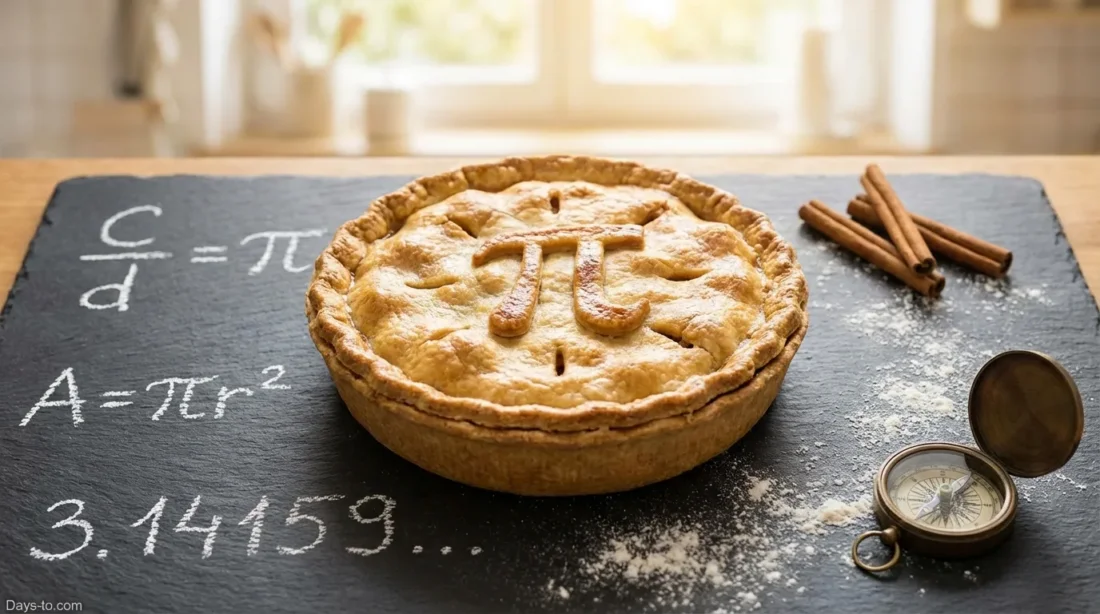
One clean formula explains the day: π = circumference ÷ diameter. Every circle carries that relationship, whether the circle is drawn in a notebook or built into a machine part.
How Pi Day Started
The modern public celebration of Pi Day began in 1988 at the Exploratorium in San Francisco. The event is closely linked to Larry Shaw, who helped turn the date into a yearly tradition. What made the idea work was its balance: the number itself is serious mathematics, yet the format of the celebration feels welcoming and light. That blend gave the day staying power.
Over time, Pi Day spread far beyond one museum. Classrooms adopted it. Science organizations noticed it. Math clubs built events around it. Later, March 14 also gained another layer of meaning when it became the date for the International Day of Mathematics. So the day now carries both a popular celebration and a broader educational role. Quietly, it grew.
What Pi Actually Represents
Pi is not a rounded school-only value, even though many people first meet it as 3.14. Its decimal expansion continues without ending and without settling into a repeating pattern. That makes it an irrational number. Mathematicians also classify it as transcendental, which means it does not arise as the exact solution of an ordinary algebraic equation with rational coefficients. Long story, elegant result.
In daily work, people rarely use all those digits. They choose the level of precision that fits the task. For a simple classroom exercise, 3.14 may be enough. For engineering, simulation, or advanced computation, more digits matter. Yet the idea stays the same: pi links straight lines and curves by turning a circle’s width into its full distance around.
| Shape or Measure | Expression With Pi | What It Tells You |
|---|---|---|
| Circle circumference | C = 2πr | The distance around a circle |
| Circle area | A = πr² | The space inside a circle |
| Sphere surface area | 4πr² | The outside area of a sphere |
| Sphere volume | 4/3 πr³ | The space inside a sphere |
Where Pi Appears in Daily Life
People often connect pi only with circles on paper, but its reach extends much further. Wheels, gears, pipes, lenses, speakers, clocks, cables wound on spools, rotating tools, and curved architecture all involve measurements that lead back to π. Even when users do not see the symbol directly, designers and builders often do.
- Engineering and manufacturing: machine parts, rotating components, and circular tolerances depend on pi-based formulas.
- Architecture and construction: arches, domes, curved facades, and rounded layouts use measurements shaped by π.
- Physics: waves, oscillations, and many rotational systems bring pi into equations.
- Computing and graphics: angles, motion, rendering, and simulation often rely on radians, where π appears naturally.
- Statistics and probability: bell-curve formulas and related models carry pi in places many beginners do not expect.
That is one reason Pi Day lasts as a cultural date. The number belongs to mathematics, yes, but it also belongs to everyday making, measuring, and modeling. A person may not speak about pi at lunch, but they still move through objects and systems shaped by it all day long.
Why the Number Fascinates So Many People
Part of the appeal comes from the structure of the number itself. Pi never ends, and because its digits do not repeat in a regular loop, the sequence feels both orderly and mysterious. It can be approximated, tested, and computed to vast lengths, yet it never reaches a final decimal stop. That keeps curiosity alive. Always has.
Another reason is symbolic. π stands for precision, but it also reminds people that some truths are stable even when their decimal forms continue forever. The circle changes size; the ratio does not. Small idea on the page, large idea in mathematics. That contrast gives the number its lasting pull.
How Pi Day Is Marked
Most Pi Day events bring together three things: number sense, memory, and play. Teachers may ask students to estimate circular measurements with string and rulers. Science centers might hold talks, demonstrations, or puzzle sessions. Some groups recite digits of π for fun, while others bake or share pie simply because the sound match makes the date easy to celebrate.
The food connection matters less than people think. It is memorable, yes, but the deeper point is educational access. A date that starts with a pun can still open the door to geometry, measurement, irrational numbers, or the history of mathematics. Friendly on the surface, very real underneath. Few math dates manage that balance so well.
In Classrooms
Pi Day often turns formulas into physical measurement. Students wrap string around cups, lids, and plates, then compare the results with diameter.
In Public Spaces
Museums, libraries, and math circles may hold talks, quizzes, and recitation events that make π feel social rather than distant.
Pi Day and the Culture of Memorizing Digits
One of the most recognizable parts of Pi Day is digit recitation. People challenge themselves to remember dozens, hundreds, or even thousands of digits. From a practical point of view, nobody needs that many for routine calculation. Still, memory contests endure because they turn an abstract number into a human performance. The number stays fixed; the person changes.
This memory culture also helps explain why pi feels larger than a formula. It appears in poems, mnemonics, classroom posters, digit art, and number games. Even people who do not remember more than 3.14 often know that the digits keep going. That unfinished quality makes the number memorable in a very human way.
Other Dates Often Mentioned With Pi
March 14 remains the best-known date, but a few others appear in discussions around π. July 22 is well known because 22/7 gives a classic rational estimate of pi. Some fans also notice that March 14 is the birthday of Albert Einstein, which adds another layer of mathematical and scientific association to the day.
- March 14: the best-known public date for 3.14.
- 1:59: a time nodding to 3.14159.
- July 22: a fraction-based reminder through 22/7.
Common Questions About Pi Day
Is Pi Day Only for Mathematicians?
No. Pi Day belongs to anyone curious about numbers, shapes, or how measurement works. Its broad appeal comes from the fact that pi connects pure mathematics with daily objects people can hold, roll, draw, or build.
Why Not Use Only 3.14 All the Time?
For rough work, 3.14 is often enough. For higher precision, people use more digits. The choice depends on the job. What matters is that every rounded form points back to the same underlying number, π, whose decimal expansion never ends.
Does Pi Matter Outside Geometry?
Very much so. Pi appears in trigonometry, physics, signal analysis, statistics, and computing. People first meet it through circles, but its role reaches well beyond them. Quietly, it shows up in places many learners do not expect.
Why Has Pi Day Lasted So Well?
Because the idea is easy to enter and hard to exhaust. The date is memorable, the number is real, and the subject opens into geometry, history, notation, memory, and science. Pi Day works for beginners and still leaves room for deeper mathematical thought. Rarely does one calendar date do both so neatly.