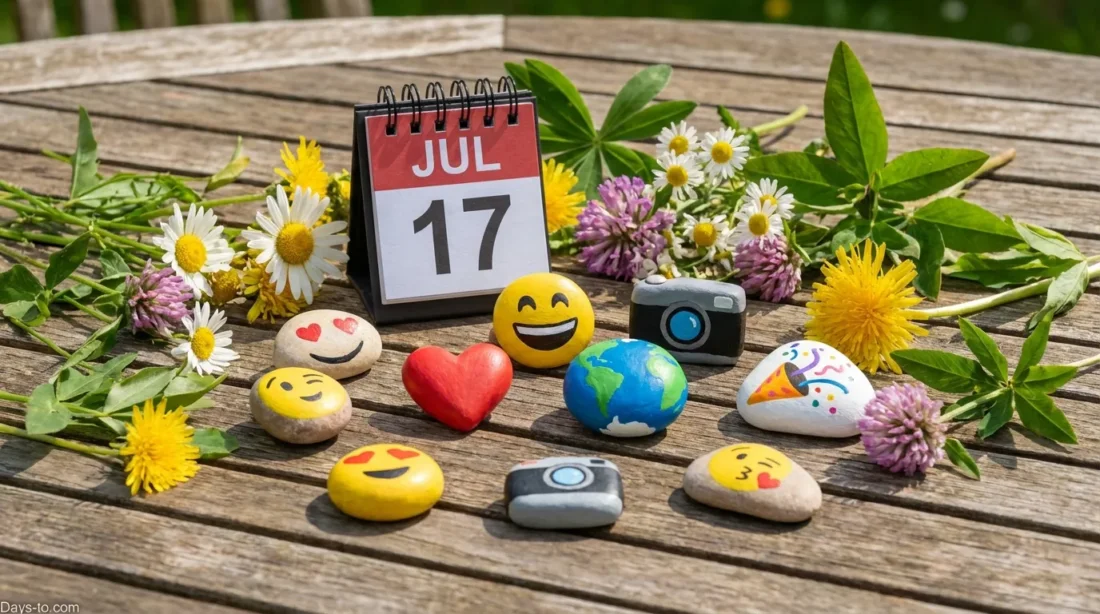
World Emoji Day
| Year | Day | Date | Days To |
|---|---|---|---|
| 2027 | Sat | July 17, 2027 | 262 days |
| 2028 | Mon | July 17, 2028 | 628 days |
| 2029 | Tue | July 17, 2029 | 993 days |
| 2030 | Wed | July 17, 2030 | 1358 days |
| 2031 | Thu | July 17, 2031 | 1723 days |
| 2032 | Sat | July 17, 2032 | 2089 days |
| 2033 | Sun | July 17, 2033 | 2454 days |
| 2034 | Mon | July 17, 2034 | 2819 days |
| 2035 | Tue | July 17, 2035 | 3184 days |
Every year on July 17, World Emoji Day marks a date that many people already know without noticing it. The clue sits inside the calendar emoji itself. Over time, this simple date became linked with emoji history, digital language, and the steady move of emoji from phone extras into everyday writing. Small symbols, yes. But used with real purpose.
Date
July 17
First Observed
2014
Main Link
Calendar Emoji
| Observed Each Year | July 17 |
| Why This Date | The calendar emoji is famously shown as July 17 |
| What the Day Highlights | Emoji use, design updates, digital culture, and shared visual language |
| Why It Matters | It gives a fixed date to a form of communication people use every day |
When World Emoji Day Is Celebrated
World Emoji Day is observed on July 17 every year. The date does not move. That makes it easy to remember, and easy to spot on calendars, event pages, and social posts. For a site focused on important dates, this one is refreshingly clear: July 17, every year, no seasonal shift, no weekday rule, no rotation.
The day has a friendly tone, yet the idea behind it is precise. It is not just a casual internet theme day. It is tied to a specific symbol, a specific date display, and a very recognizable piece of digital communication. Once you know that link, the date makes immediate sense.
Why July 17 Was Chosen
July 17 was chosen because it is the date most famously shown on the calendar emoji. That visual detail turned a normal day into a natural choice for an annual observance. The logic is simple, and that is part of why it lasted. No forced symbolism. Just a date people were already seeing on their screens.
For many users, the calendar emoji became the quiet emblem of the day. It works almost like built-in branding, though it started as a design detail. A small one. Still, it gave World Emoji Day something many annual observances never get: a ready-made symbol that already lives inside phones, apps, and keyboards.
July 17 stands out because the date is already embedded in the visual language of the calendar emoji.
How the Calendar Emoji Shaped the Date
The date came first in the icon, and the observance followed. Not the other way around. That order matters because it explains why World Emoji Day feels natural rather than invented just for effect. A familiar image was already there; the celebration simply gave that image a public meaning.
Across platforms, emoji artwork can vary in shape and style. Yet the July 17 connection became widely recognized, and that made the date stronger year after year. Quietly, very quietly, a design cue turned into a fixed point in digital culture.
How World Emoji Day Began
World Emoji Day began in 2014. It was created by Jeremy Burge, a name closely associated with emoji reference work and public discussion around emoji design. The first observance was modest in scale, but the idea had clarity. That helped. People understood the date fast, and the topic already touched daily life.
As the day gained attention, it became a regular moment for emoji-related announcements, public conversation, and wider media coverage. Tech platforms, publishers, and everyday users all found a place in it. Some marked the day by sharing favorite emoji. Others used it to discuss new emoji releases, design changes, or how emoji meaning shifts with context.
That growth makes sense. Emoji are small, but their reach is not. Once the date became familiar, World Emoji Day gave people a simple annual marker for a subject they were already using in messages, captions, comments, and work chats (yes, even there).
A Short Timeline of Emoji and the Day
| Year | What Happened |
|---|---|
| Late 1990s | Early emoji sets gained attention on Japanese mobile phones, shaping the idea of picture-based text symbols. |
| 2010 | Emoji entered the Unicode Standard, which helped them work across devices and software systems. |
| 2014 | World Emoji Day was first observed on July 17. |
| 2016 and After | The date became a regular point for emoji news, public events, awards, and preview announcements. |
| Today | World Emoji Day is widely recognized as the best-known annual date linked with emoji culture. |
This timeline shows why World Emoji Day fits well on a date-focused website. It is not only about a symbol people like. It also reflects the path from early mobile design to standardized digital writing. Emoji did not stay a novelty for long. Into daily language they moved, and they stayed.
How Emoji Became Part of Daily Writing
Emoji became more useful once they could appear across many devices in a more consistent way. That is where Unicode matters. Unicode gives shared text standards to digital characters, and emoji benefited from that system. Without that kind of standardization, an emoji might stay trapped inside one phone maker, one service, or one region. With it, emoji became portable.
People use emoji for tone, pace, warmth, and brevity. A single symbol can soften a sentence, mark celebration, show gratitude, or add emotional color that plain text may leave out. Not always. But often. That everyday value explains why World Emoji Day has staying power far beyond novelty.
The day also draws attention to the scale of emoji use. Emoji are not niche symbols. They are part of mainstream communication now, used in private messages, public posts, support pages, headlines, classroom materials, and brand updates. Casual in form, yes, but not trivial.
Emoji, Emoticons, and Stickers Are Not the Same
- Emoji are standardized digital characters, such as 😀 or 🌍.
- Emoticons are text-made faces, such as 🙂 or ^_^.
- Stickers are image-based graphics used inside apps and are usually not part of the Unicode character set.
This difference matters because World Emoji Day is about emoji in the strict sense, not every visual reaction used online. The day centers on the symbols that became part of standard digital text. That point is technical, but it changes the story in a useful way.
What the Day Celebrates
World Emoji Day celebrates more than colorful icons. It highlights how people share feeling, tone, humor, and identity in compact visual form. It also brings attention to design choices, platform updates, and the ongoing discussion about which symbols deserve a place on modern keyboards.
- Shared Visual Language — emoji help people communicate quickly across many contexts.
- Design Evolution — each platform interprets the same emoji in its own visual style.
- Cultural Reach — emoji appear in personal, educational, and public communication.
- Annual Attention — July 17 gives one fixed day to revisit how emoji are used and updated.
That makes the day feel both light and informative. One part celebration, one part reflection. On some years, attention falls on new emoji proposals. On others, the focus shifts to meaning, accessibility, or design differences between platforms. The date stays the same. The conversation changes.
Why World Emoji Day Still Matters
Many annual observances fade because they depend on promotion alone. World Emoji Day holds on because the subject stays present in daily life. People use emoji constantly, often without a second thought. That habit gives the date a real base. It is tied to behavior, not just branding.
The day also sits at the meeting point of language, design, and technology. Emoji are simple to send, but the system behind them involves standards, proposals, visual interpretation, and platform rollout. So while the symbols look playful, the story around them is fuller than it seems.
That is why July 17 keeps returning to public attention. Not loudly every time, but steadily. A fixed date, a familiar icon, and a form of writing people already use every day. For a modern calendar of notable dates, it earns its place.