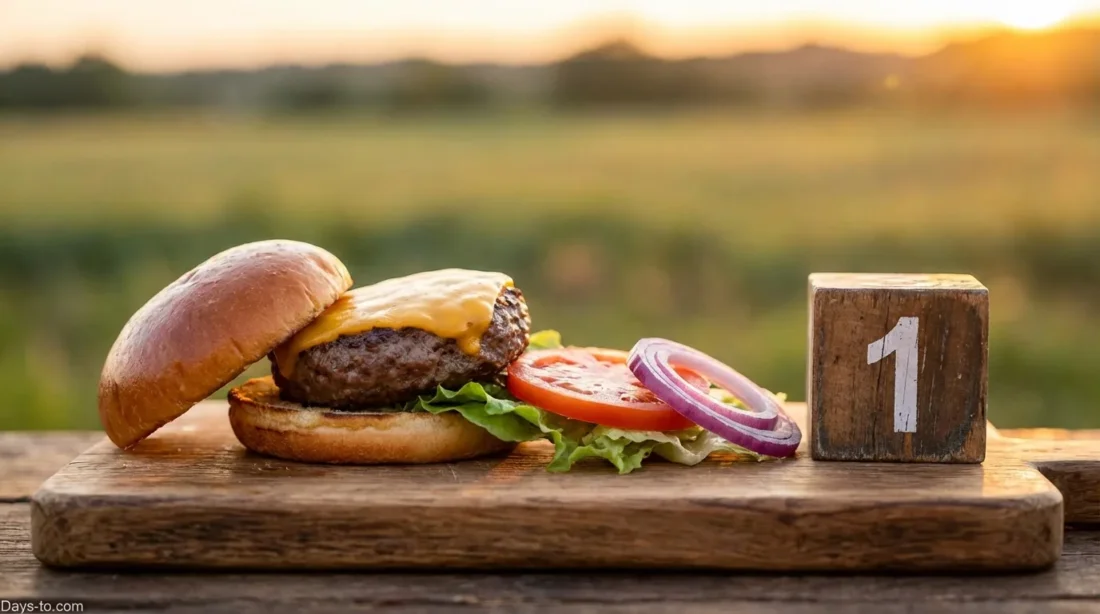
National Burger Day
| Year | Day | Date | Days To |
|---|---|---|---|
| 2027 | Fri | May 28, 2027 | 212 days |
| 2028 | Sun | May 28, 2028 | 578 days |
| 2029 | Mon | May 28, 2029 | 943 days |
| 2030 | Tue | May 28, 2030 | 1308 days |
| 2031 | Wed | May 28, 2031 | 1673 days |
| 2032 | Fri | May 28, 2032 | 2039 days |
| 2033 | Sat | May 28, 2033 | 2404 days |
| 2034 | Sun | May 28, 2034 | 2769 days |
| 2035 | Mon | May 28, 2035 | 3134 days |
National Burger Day falls on May 28 each year. On many calendars, that same date also appears as National Hamburger Day. The timing feels natural: it lands late in May, the month widely linked with burger-themed food observances, and it fits the season when the burger moves to the center of menus, home kitchens, and outdoor meals.
National Burger Day Date and Meaning
| Topic | Details |
|---|---|
| Date | May 28 each year |
| Common Alternate Name | National Hamburger Day |
| Seasonal Setting | Late May, near the start of the warm-weather grilling period |
| Main Focus | The burger as a familiar sandwich, a restaurant staple, and a lasting part of everyday food culture |
| Broader Calendar Link | May is often treated as National Hamburger Month |
For most readers, National Burger Day is easy to understand because the food itself is easy to recognize. A round patty, bread, toppings, and a format built to be held in the hand. Still, the name carries more than one layer. In daily speech, burger feels broad and modern, while hamburger sounds older and more traditional.
That small difference in wording matters. On holiday calendars, National Burger Day and National Hamburger Day often point to the same observance. People use the shorter word because it covers the classic beef burger, but it also leaves room for newer forms people know well today (cheeseburgers, chicken burgers, plant-based burgers, and more). Same shape. Same idea. A wider label.
The Name Still Matters
The word hamburger does not come from ham. It traces back to Hamburg and to the older idea of a Hamburg-style minced beef dish. Later, that meat preparation moved into sandwich form in the United States. The modern burger kept the name, even as the food itself kept changing.
Why May 28 Stays Attached to the Burger
May 28 works because it sits at the end of May, just when burger season feels fully present in everyday life. Food observances often settle around dates that are easy to remember and easy to connect with habits people already have. The burger fits that pattern well. Late spring, warm evenings, simpler meals, familiar menu choices.
No single public institution controls every food holiday, so these observances often grow through repeated calendar use rather than through one formal starting point. That is why National Burger Day feels both fixed and informal at the same time. The date holds because people keep using it, publishing it, and recognizing it year after year. Once a food date becomes familiar, it tends to stay familiar.
How the Burger Reached This Day
The early story of the burger is not perfectly tidy. Several places and several names appear in its background. Even so, the broader path is fairly clear. The meat element usually connects to Hamburg-style beef traditions, and the sandwich form took shape in the United States as ground beef became easier to prepare, sell, and serve in a quick, practical way.
One of the most repeated early claims points to Louis Lassen and Louis’ Lunch in New Haven in 1900. Other fairground and lunch-counter stories also appear in burger history, which is why the first true hamburger sandwich remains hard to pin to one moment with total certainty. Easy to name, harder to date exactly, the burger is. Yet by the early 20th century, the sandwich had clearly taken hold.
| Period | What Happened |
|---|---|
| 19th Century | Hamburg-style minced beef becomes familiar in the United States through immigrant food traditions and changing eating habits. |
| Around 1900 | Early claims for the hamburger sandwich appear in lunch counters and fair settings, with New Haven often mentioned in the story. |
| 1921 | White Castle helps standardize the burger as a fast, repeatable restaurant item with a clear identity. |
| Mid-20th Century and After | The burger becomes a daily staple in diners, chains, and home cooking, then expands into many regional and modern versions. |
Standardization changed everything. Once restaurants could make the burger look, taste, and feel familiar from one visit to the next, the sandwich moved from novelty to routine. Then came the next shift: variation. Cheese, bacon, mushrooms, onion, pickles, sauces, smashed patties, larger buns, smaller sliders. The structure stayed stable, but the details kept moving.
What the Word Burger Usually Covers
In strict older usage, hamburger points to a ground beef patty served as a sandwich. In present-day use, burger works more broadly. It can still mean the classic beef version, of course. It can also describe a sandwich built in the same form but made with chicken, turkey, beans, mushrooms, lentils, or plant-based mixtures. The shape and eating style do a lot of the work.
Classic Burger Elements
- Patty as the center of the sandwich
- Bread or bun that holds the structure together
- Toppings such as lettuce, onion, tomato, or pickles
- Sauce or seasoning for flavor balance
- A format meant to be hand-held and direct
How the Modern Burger Expanded
- Cheeseburger versions became standard menu items
- Regional toppings gave local identity to the same basic form
- Smash burgers and thicker patties changed texture, not the core idea
- Non-beef burgers widened the meaning of the word
- The burger format stayed recognizable across all these changes
That range helps explain why National Burger Day remains easy to understand across generations. People may disagree on the best bun, the right cheese, or whether a smashed edge beats a thicker patty. The shared picture stays intact. A burger is one of those rare foods that can feel standard and personal at the same time.
National Burger Day and Similar Food Dates
| Observance | Date | How It Is Usually Understood |
|---|---|---|
| National Burger Day | May 28 | A broad celebration of the burger in its best-known forms |
| National Hamburger Day | May 28 | Often treated as the same observance, with an older name |
| National Hamburger Month | May | A month-long calendar setting that gives extra context to burger-related observances |
| National Cheeseburger Day | September 18 | A separate food date centered on the cheese-topped version |
For searchers, the overlap can be confusing. Someone may look for National Burger Day and land on a page titled National Hamburger Day, or the other way around. In practice, those searches often point to the same date and the same general subject. The difference is usually editorial wording, not a different observance.
Common Questions About National Burger Day
Is National Burger Day Always on May 28?
Yes. National Burger Day is commonly listed on May 28 each year. Because it is a date-based food observance, the weekday changes from year to year, but the calendar date stays the same.
Is It the Same as National Hamburger Day?
In most cases, yes. Many publishers use National Burger Day and National Hamburger Day as two names for the same May 28 observance. The shorter form feels broader, while the older form feels more traditional.
Does the Burger Have One Proven Inventor?
No single origin story settles every question. Several early claims appear in the history of the hamburger sandwich, and more than one place is tied to its rise. A well-known claim links the sandwich to New Haven in 1900, yet the larger story matters more than one perfect first date: the burger grew fast once it matched the pace of modern eating.
Why Does the Word Hamburger Stay in Use?
The term hamburger stayed because it was already established before the shorter word burger became the everyday favorite. Even now, both labels remain active. One sounds more classic, one sounds more flexible. Side by side, they still describe the same familiar sandwich tradition.
Does National Burger Day Refer Only to Beef Burgers?
Historically, the core meaning points to a beef patty. In current use, the word burger reaches much farther. Readers often use it for any sandwich built in the burger style, even when the filling is poultry, vegetables, beans, or plant-based ingredients. Language changed. The format stayed.