Nba Finals
| Year | Day | Date | Days To |
|---|---|---|---|
| 2026 | Thu | June 4, 2026 | 58 days |
The NBA Finals is the last series of the NBA season. It decides the league champion, awards the Larry O’Brien Trophy, and turns months of regular-season work into one best-of-seven test. Today, the Finals brings together the Eastern Conference champion and the Western Conference champion, so every game carries a different kind of weight. There is no next round. This is the finish line.
Main Points of the NBA Finals
Purpose: to crown the NBA champion after the playoff bracket is complete.
Series Length: first team to four wins takes the title.
Main Awards: team trophy and Finals MVP.
| Part | What It Means |
|---|---|
| League Stage | Final round of the NBA playoffs |
| Teams | East champion vs West champion |
| Wins Needed | 4 wins |
| Current Home Pattern | 2-2-1-1-1 |
| Team Prize | Larry O’Brien Trophy |
| Individual Prize | Bill Russell NBA Finals MVP Award |
| Usual Time of Year | June |
How the Series Is Played
The NBA Finals uses a best-of-seven format. A team does not need to play all seven games; the series ends as soon as one side reaches four wins. The club with the better regular-season record gets home-court advantage, which matters because it controls where Games 1, 2, 5, and 7 are played. Small edge, yes. Sometimes a very real one.
- Games 1 and 2: played at the arena of the team with home-court advantage
- Games 3 and 4: played at the other team’s arena
- Game 5: back to the team with home-court advantage if needed
- Game 6: back to the other team if needed
- Game 7: played on the floor of the team with the better regular-season record if the series is tied 3-3
| Game | Site | Only If Needed? |
|---|---|---|
| Game 1 | Home-court team | No |
| Game 2 | Home-court team | No |
| Game 3 | Other finalist | No |
| Game 4 | Other finalist | No |
| Game 5 | Home-court team | Yes |
| Game 6 | Other finalist | Yes |
| Game 7 | Home-court team | Yes |
Historic Milestones in the NBA Finals
The first championship series in this line was played in 1947, when the league still used the BAA name. That is why older records can look a little different on the page even though they belong to the same title history. Later, after the BAA and NBL merger formed the NBA, the championship series moved into the record book as part of NBA history. Same destination, older road signs.
- 1947: the first title series in the Finals lineage was played
- 1969: the Finals MVP award was introduced
- 2014: the Finals returned to the 2-2-1-1-1 home pattern used today
One detail worth knowing: the Finals MVP began in 1969, and Jerry West remains the only player to win it from the losing team. That detail still stands out because it says a lot about how overwhelming one performance can be, even inside a losing series.
What Changes Inside a Finals Matchup
A Finals series can look very different from the earlier playoff rounds. Rotations often get tighter. Coaches lean harder on their top seven or eight players. Opponents know each other in far more detail, so small tactical choices start to matter: which defender picks up the star ball-handler, which corner shooter gets helped off, how many minutes a center can stay on the floor, when a team switches, when it traps, when it stays home. Tiny choices. Big result.
- Shot quality matters more: teams try to remove a rival’s favorite looks, not just lower the total score
- Bench depth gets tested: one steady reserve can swing a game, then a series
- Foul trouble hurts more: a missing starter changes both ends of the floor
- Late-game execution becomes central: half-court offense, free throws, and final-possession defense often decide the night
- Momentum shifts fast: a series can turn on one hot shooting quarter or one road win
Trophies and Awards
Larry O’Brien Trophy
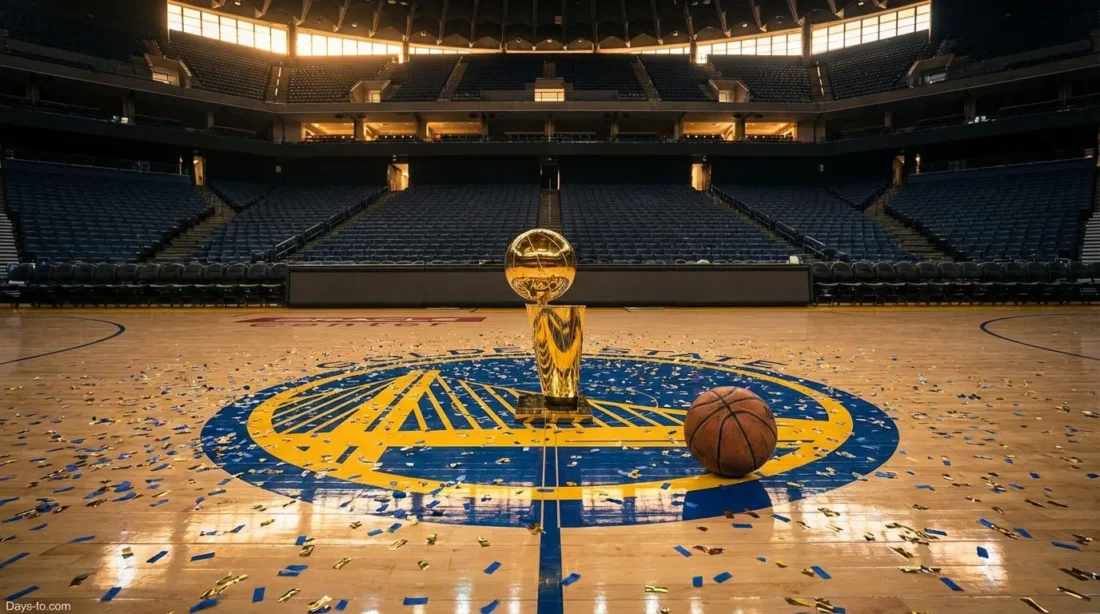
The winning team lifts the Larry O’Brien Trophy. In practical terms, this is the official sign of the league title. Once that trophy is raised, the season is settled. No debate left on the bracket.
Bill Russell Finals MVP
The standout player in the series receives the Bill Russell NBA Finals MVP Award. This honor does not simply follow the biggest name. It usually follows the player who most clearly shaped the result, game after game.
That is why the NBA Finals carries so much weight in player legacy. A regular-season award says one thing. A scoring title says another. Yet a great Finals run, with the whole league watching, often becomes the memory people return to first. Years later, they still remember the shot, the block, the stop, the steal, the fourth-quarter burst. They remember who delivered when the season had narrowed to one series.
Teams and Eras That Shaped the Finals
| Era | Teams Often Linked to the Finals | Why That Period Stands Out |
|---|---|---|
| 1950s and 1960s | Boston Celtics | Built the early standard for championship basketball and produced the longest title run in Finals history. |
| 1980s | Celtics and Lakers | Turned the Finals into a yearly showcase built around star power, rivalry, and national attention. |
| 1990s | Chicago Bulls | Two three-peats made this decade one of the clearest dynasty periods the Finals has seen. |
| 2000s into Early 2010s | Lakers and Spurs | Showed two different paths to the same goal: elite stars on one side, long-term structure and discipline on the other. |
| Mid-2010s into 2020s | Warriors and a wider mix of champions | Spacing, three-point volume, and faster decision-making changed how many Finals games were played and read. |
This is one reason the NBA Finals works as more than a championship round. It also works as a record of change. You can track how basketball evolved by looking at Finals film and Finals box scores: slower pace to faster pace, more post play to more space, fewer threes to more threes, shorter benches in certain matchups, more switching on defense, and more value placed on players who can score, pass, and defend without needing the ball every trip.
Why the Finals Still Matters So Much
The Finals matters because it is where team history and player legacy meet the same test. A franchise can spend years building toward one opening. A player can spend a career chasing one clean chance. Then the series begins, and all the long plans narrow into a few games, a few matchups, a few possessions. Strange, in a way. An 82-game season, and sometimes everything swings on one night.
That is why the NBA Finals never feels like just another playoff round. It is the point where structure, skill, endurance, coaching, and timing all have to hold together at once. When they do, a team becomes champion. When they do not, the series becomes part of the next season’s motivation. And so the history keeps moving, year after year, one title at a time.