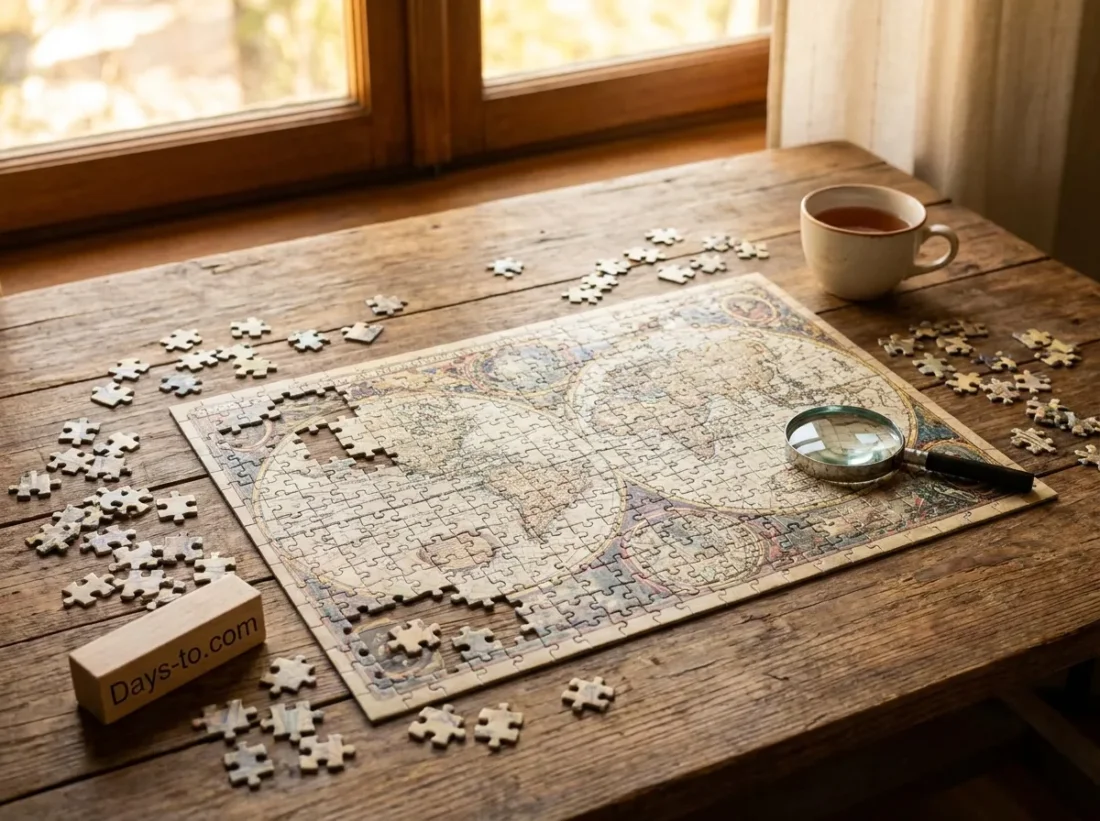
National Puzzle Day
| Year | Day | Date | Days To |
|---|---|---|---|
| 2027 | Fri | January 29, 2027 | 102 days |
| 2028 | Sat | January 29, 2028 | 467 days |
| 2029 | Mon | January 29, 2029 | 833 days |
| 2030 | Tue | January 29, 2030 | 1198 days |
| 2031 | Wed | January 29, 2031 | 1563 days |
| 2032 | Thu | January 29, 2032 | 1928 days |
| 2033 | Sat | January 29, 2033 | 2294 days |
| 2034 | Sun | January 29, 2034 | 2659 days |
| 2035 | Mon | January 29, 2035 | 3024 days |
National Puzzle Day returns every year on January 29. The countdown shows the exact time remaining until the next observance, then moves forward to the following listed date. Because the celebration uses a fixed calendar date, its future dates can be calculated well in advance.
When Is National Puzzle Day?
National Puzzle Day is observed on January 29. The countdown automatically selects the nearest listed January 29. It is an informal observance centered on jigsaw puzzles, crosswords, riddles, logic games, number puzzles, word searches, mechanical puzzles, and other forms of problem-solving.
The date does not move to a Monday or weekend. January 29 remains the date, while the weekday changes from year to year.
National Puzzle Day Dates Through 2035
The table lists the observance dates and weekdays through 2035. Leap years affect the weekday sequence after February, but the January 29 date itself never changes.
| Year | Date | Day |
|---|---|---|
| 2027 | January 29, 2027 | Friday |
| 2028 | January 29, 2028 | Saturday |
| 2029 | January 29, 2029 | Monday |
| 2030 | January 29, 2030 | Tuesday |
| 2031 | January 29, 2031 | Wednesday |
| 2032 | January 29, 2032 | Thursday |
| 2033 | January 29, 2033 | Saturday |
| 2034 | January 29, 2034 | Sunday |
| 2035 | January 29, 2035 | Monday |
What National Puzzle Day Celebrates
National Puzzle Day celebrates structured problems made for solving. A puzzle may ask a player to assemble an image, identify a pattern, find a hidden word, arrange shapes, decode a clue, or reach a target through a set of rules. The form changes. The central activity does not: a person studies the available information and works toward an answer.
The observance is associated with puzzle maker Jodi Jill, who promotes January 29 as a day for people to solve and share puzzles. It is not a public holiday, and it does not alter official schedules. Its role is cultural and recreational, with schools, libraries, clubs, families, and puzzle fans choosing their own ways to mark the date.
Fixed Date
January 29 is used every year. Only the weekday changes.
Informal Observance
It is a recreational occasion, not a federal or statutory holiday.
Open Format
Any puzzle type can be part of the day, from crosswords to three-dimensional models.
Puzzle Types Connected To The Day
Jigsaw Puzzles
Jigsaw puzzles divide a picture into interlocking pieces that must be placed in their correct positions. Solvers often begin with edge pieces, then group pieces by color, texture, shape, or image detail. Piece counts range from small children’s sets to large puzzles containing several thousand pieces.
The earliest commercial ancestors were wooden map puzzles made for teaching geography. Later versions used printed scenes, paintings, photographs, and original artwork. Cardboard production made them less expensive and easier to distribute. Today, wooden, cardboard, acrylic, magnetic, and digital versions all exist.
Crosswords and Word Puzzles
Crosswords use intersecting answers placed inside a numbered grid. Each clue points toward a word or phrase, and shared letters help confirm nearby answers. Other word-based formats include anagrams, cryptograms, acrostics, word searches, rebuses, letter-box puzzles, and missing-word challenges.
Language puzzles may test vocabulary, spelling, cultural knowledge, or the ability to read a clue in more than one way. A short clue can be direct. Another may depend on a pun, an abbreviation, or a carefully chosen definition.
Logic and Number Puzzles
Logic puzzles give the solver a set of conditions and ask for the only arrangement that satisfies them. Number grids, deduction tables, sequence problems, river-crossing problems, and truth-teller riddles belong to this broad group. Sudoku is one familiar example: numbers are used as symbols, but the task depends on placement and elimination rather than arithmetic.
Some number puzzles do require calculation. Magic squares, arithmetic paths, equation puzzles, and number pyramids may involve addition, subtraction, multiplication, division, or pattern finding. Clear rules matter. Without them, a difficult puzzle becomes a guessing exercise.
Mechanical and Three-Dimensional Puzzles
Mechanical puzzles must be moved, opened, separated, assembled, or rearranged. Twisty cubes, disentanglement puzzles, puzzle boxes, sliding tiles, interlocking burr puzzles, and packing problems all rely on physical manipulation. The object itself carries the rules.
Three-dimensional puzzles add depth and orientation. A piece may look correct from one angle yet block a later step. Slow inspection often works better than force. That restraint is part of the solve.
How The Countdown Works
The countdown measures the interval between the present moment and the next listed January 29. It may display days alone or divide the remaining time into days, hours, minutes, and seconds, depending on the site’s countdown settings.
- Before January 29: the timer counts down to that year’s observance.
- On January 29: the timer reaches the event date.
- After January 29: the timer advances to January 29 of the next listed year.
A fixed annual date makes long-range calculation straightforward. There is no need to identify a particular weekday, lunar phase, or numbered week of the month.
Why The Weekday Changes
A standard year has 365 days, which is 52 full weeks plus one day. For that reason, January 29 normally moves forward by one weekday in the following year. A leap year has 366 days, but the extra day falls after January 29. Its effect appears in dates later in the calendar and in the weekday pattern of the next year.
This is why the sequence can jump over a weekday. National Puzzle Day falls on Saturday in 2028 and Monday in 2029, with Sunday skipped in that transition. The 2028 leap day changes the calendar alignment after February.
National Puzzle Day and Puzzle History
The Early Jigsaw Puzzle
The early form of the jigsaw puzzle is often linked to John Spilsbury, a London mapmaker and engraver. Around the 1760s, printed maps were mounted on wood and cut along geographic boundaries. Students could rebuild the map by fitting countries or regions back together. These teaching aids were first known as dissections.
The name “jigsaw puzzle” arrived much later. Early wooden puzzles were cut with hand tools, while later manufacturing used treadle saws and mechanical cutting methods. Cardboard puzzles became common during the twentieth century, widening access and allowing publishers to produce more themes and piece counts.
Crosswords Enter Daily Life
The modern crossword became a newspaper feature in the early twentieth century. Its compact grid suited print pages, and regular publication turned puzzle solving into a daily habit for many readers. Different traditions developed, including direct-definition crosswords, American-style blocked grids, barred grids, and cryptic crosswords.
Crosswords also created a shared solving language. Entries cross. Clues have lengths. Abbreviations follow house rules. Experienced solvers learn to notice these conventions, while new solvers gain confidence one answer at a time.
Modern Puzzle Formats
Printed puzzles remain widely used, yet digital formats have changed how puzzles are delivered. Apps and websites can generate new grids, record solving times, reveal hints, check entries, and support daily challenges. Physical puzzle design has also expanded through laser cutting, 3D printing, magnets, new materials, and precision manufacturing.
The medium changed; the appeal stayed familiar. A solver still faces a limited set of clues, pieces, symbols, or movements and searches for order within them.
How Schools and Libraries Mark The Day
Schools and libraries often use National Puzzle Day for group solving, puzzle displays, classroom challenges, and family activities. A library may place a shared jigsaw on a table so visitors can add pieces during the day. A classroom may rotate students through word, number, spatial, and logic stations.
Puzzle exchanges are another common format. Participants bring a complete used puzzle and trade it for a different one. This keeps materials in circulation and gives solvers a new challenge without requiring a formal event schedule.
Competitive events may use identical puzzle sets and a shared time limit. In cooperative events, the goal is different: participants divide tasks, compare observations, and combine partial answers. Both formats fit the date because the observance does not prescribe one official activity.
Skills Used While Solving Puzzles
Pattern Recognition
Puzzles often depend on noticing repeated forms, colors, letter groups, numerical relationships, or movement rules. Pattern recognition helps a solver separate useful structure from distracting detail. Once a pattern appears, earlier clues may become easier to interpret.
Memory and Attention
A solver may need to remember attempted positions, rejected answers, clue wording, piece shapes, or earlier deductions. Attention also shifts between the whole problem and a small detail. Too narrow, and the larger pattern disappears. Too broad, and a useful clue may be missed.
Spatial Reasoning
Spatial reasoning supports jigsaws, tangrams, mazes, packing puzzles, block arrangements, and three-dimensional models. Solvers compare size, direction, rotation, distance, and fit. Some solutions appear only after a piece is mentally turned or viewed from another position.
Language and Number Skills
Word puzzles draw on spelling, definitions, synonyms, sound, grammar, and context. Number puzzles may use arithmetic, sequences, parity, place value, or elimination. Many puzzles mix these skills. A code puzzle, for example, can require letter analysis and numerical substitution at the same time.
Questions About National Puzzle Day
What date is National Puzzle Day?
National Puzzle Day is observed every year on January 29.
When is the next National Puzzle Day?
The live countdown identifies the nearest listed January 29 and measures the time remaining until that date.
Is National Puzzle Day on the same date every year?
Yes. It always falls on January 29. The weekday changes because the calendar advances by one weekday in a standard year and follows a different sequence around leap years.
Is National Puzzle Day a public holiday?
No. It is an informal observance rather than a public holiday. Schools, banks, businesses, and government offices generally follow their normal schedules.
Which puzzles count for National Puzzle Day?
All puzzle forms can be included. Common choices include jigsaws, crosswords, Sudoku, riddles, logic grids, tangrams, word searches, cryptograms, mazes, puzzle boxes, sliding tiles, and twisty puzzles.
Who is associated with National Puzzle Day?
Puzzle maker Jodi Jill is associated with founding and promoting the January 29 observance.