Memorial Day
| Year | Day | Date | Days To |
|---|---|---|---|
| 2026 | Mon | May 25, 2026 | 46 days |
| 2027 | Mon | May 31, 2027 | 417 days |
| 2028 | Mon | May 29, 2028 | 781 days |
| 2029 | Mon | May 28, 2029 | 1145 days |
| 2030 | Mon | May 27, 2030 | 1509 days |
| 2031 | Mon | May 26, 2031 | 1873 days |
| 2032 | Mon | May 31, 2032 | 2244 days |
| 2033 | Mon | May 30, 2033 | 2608 days |
| 2034 | Mon | May 29, 2034 | 2972 days |
| 2035 | Mon | May 28, 2035 | 3336 days |
The last Monday in May serves as a solemn anchor for the American calendar, marking a day of national mourning and remembrance. While many view it as the unofficial start of summer, the core purpose of Memorial Day is strictly to honor military personnel who died in service to their country. This distinction is vital, separating it from Veterans Day, which celebrates all who have served. The holiday’s roots go deep into the fractured history of the Civil War, reflecting a nation’s need to heal through the collective act of honoring its fallen.
| Time Period | Key Development | Significance |
|---|---|---|
| 1868 | General Order No. 11 | General John A. Logan officially proclaimed Decoration Day to honor Union soldiers. |
| 1873 | State Recognition | New York became the first state to designate it as a legal holiday. |
| 1968 | Uniform Monday Holiday Act | Congress moved the observance to the last Monday in May to create a three-day weekend. |
| 2000 | National Moment of Remembrance | A resolution asking Americans to pause at 3:00 p.m. local time. |
The Origins of Decoration Day
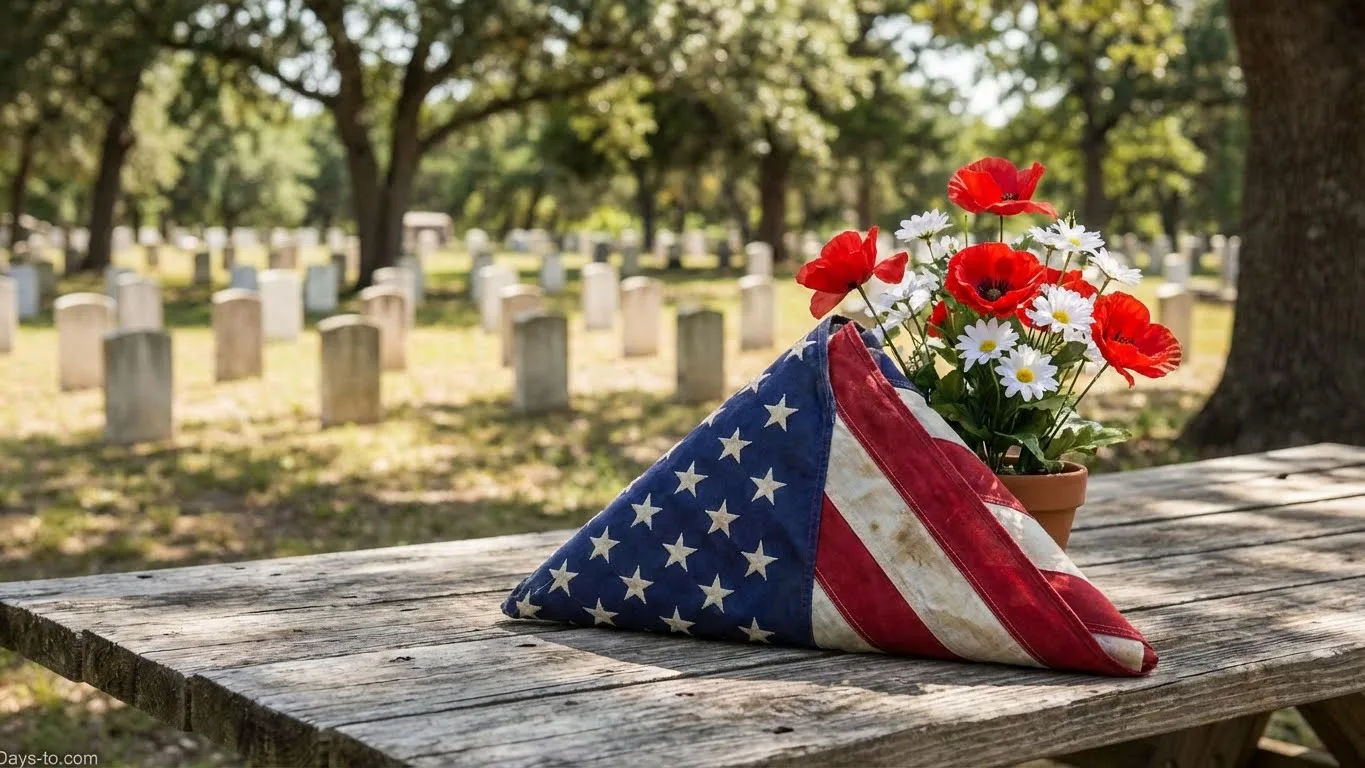
Before the name Memorial Day became standard, the holiday was widely known as Decoration Day. The Civil War claimed more lives than any conflict in U.S. history, necessitating the establishment of the country’s first national cemeteries. By the late 1860s, communities across America had begun holding springtime tributes. They would decorate the graves of fallen soldiers with flowers and flags, reciting prayers in a collective display of grief. Although several towns claim to be the birthplace of this tradition, the federal goverment eventually declared Waterloo, New York, as the official birthplace of the holiday.
General John A. Logan, leader of an organization for Northern Civil War veterans, called for a nationwide day of remembrance later in May. He chose May 30th specifically because it was not the anniversary of any particular battle. According to historical accounts, this date was selected largely because flowers would be in bloom all over the country, ensuring plenty of resources for decorating graves.
Evolution into a Federal Holiday
For decades, Memorial Day continued to be observed on May 30. However, the nature of the holiday began to shift after World War I. Originally dedicated to honoring those lost in the Civil War, the observance expanded to include American military personnel who died in all wars. This broader scope solidified its place as a day of national rather than just sectional remembrance. The most important administrative change occurred in 1968 with the passage of the Uniform Monday Holiday Act. This legislation moved Washington’s Birthday, Memorial Day, and several others to Mondays, establishing the familiar long weekend structure used today.
Protocols regarding the American Flag
Observing the flag code is an important part of the day. Unlike other holidays where the flag flies at full staff, Memorial Day has a unique half-staff protocol. At sunrise, the flag is raised quickly to the top of the staff and then solemnly lowered to the half-staff position, where it remains until noon. This position honors the million-plus men and women who gave their lives for their country. At noon, the flag is raised to full-staff for the remainder of the day. This symbolic gesture represents the living nation resolving not to let their sacrifice be in vain but to rise and continue the fight for liberty.
The Red Poppy Tradition
The wearing of a red poppy has become synonymous with Memorial Day, a tradition inspired by the poem “In Flanders Fields” written during the First World War. Lieutenant Colonel John McCrae, a Canadian physician, wrote of the bright red flowers growing among the graves of soldiers. Moina Michael, an American professor, was so moved by the poem that she campaigned to adopt the poppy as a national symbol of remembrance. Today, veterans organizations distribute these artificial flowers as a way to raise funds and awareness. It serves as a visual reminder of the blood shed during combat and the hope for peace.
The National Moment of Remembrance
In an effort to return the focus of the holiday to its sacred roots, Congress passed the National Moment of Remembrance Act in 2000. This legislation asks all Americans to pause for one minute at 3:00 p.m. local time. This specific time was chosen because it is typically when many Americans are enjoying their holiday gatherings. The pause serves as a unifying act, interrupting festivities to acknowledge the freedom that allows such gatherings to take place. Major League Baseball games, moving vehicles, and other institutions often halt operations briefly to observe this moment of silence.
Arlington National Cemetery Traditions
The most visible national ceremony takes place at Arlington National Cemetery in Virginia. Each year, the President or Vice President lays a wreath at the Tomb of the Unknown Soldier. Prior to this event, soldiers from the 3rd U.S. Infantry Regiment, known as “The Old Guard,” conduct “Flags In.” During this massive operation, soldiers place small American flags approximately one foot in front of more than 280,000 headstones. This visual tribute transforms the rolling green hills into a sea of red, white, and blue, ensuring that no individual grave is left unvisited during the holiday weekend.