Hanukkah
| Year | Day | Date | Days To |
|---|---|---|---|
| 2026 | Sat | December 5, 2026 | 242 days |
| 2027 | Sat | December 25, 2027 | 627 days |
| 2028 | Wed | December 13, 2028 | 981 days |
| 2029 | Sun | December 2, 2029 | 1335 days |
| 2030 | Sat | December 21, 2030 | 1719 days |
| 2031 | Wed | December 10, 2031 | 2073 days |
| 2032 | Sun | November 28, 2032 | 2427 days |
| 2033 | Sat | December 17, 2033 | 2811 days |
| 2034 | Thu | December 7, 2034 | 3166 days |
| 2035 | Wed | December 26, 2035 | 3550 days |
Hanukkah, widely known as the Festival of Lights, stands as one of the most observable and cherished holidays in the Jewish calendar. It is an eight-day celebration that commemorates the rededication of the Second Temple in Jerusalem. Unlike many other major religious observances that require strictly refraining from work, this festival focuses heavily on home-based traditions and public displays of faith. Families gather nightly to kindle lights, recite specific blessings, and acknowledge a historical moment of spiritual survival.
Historical Background and The Miracle
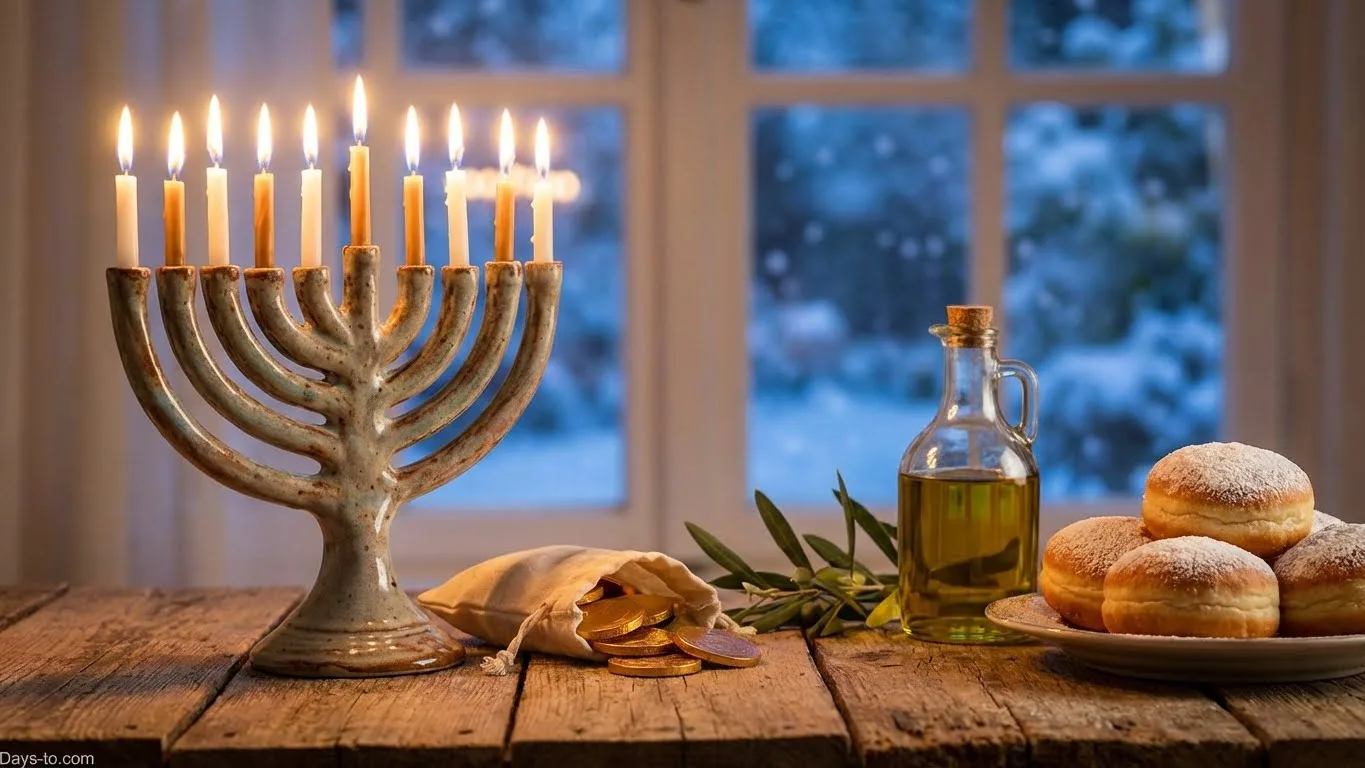
The origins trace back to the second century BCE. At that time, the Holy Land was ruled by the Seleucids (Syrian-Greeks), who attempted to force the people of Israel to accept Greek culture and beliefs. A small group of faithful Jews, led by Judah the Maccabee, defeated one of the mightiest armies on earth, drove the Greeks from the land, and reclaimed the Holy Temple in Jerusalem. When they sought to light the Temple’s Menorah (the seven-branched candelabrum), they found only a single cruse of olive oil that had escaped contamination. Miraculously, that one-day supply burned for eight full days, until new oil could be prepared under conditions of ritual purity.
The Hanukkiah
Central to the holiday is the lighting of the hanukkiah, a candelabra with nine branches. This is distinct from the seven-branched menorah used in the ancient Temple. Eight of the branches hold lights (candles or oil lamps) to symbolize the eight days of the miracle. The ninth branch is called the shamash, or helper light. The shamash sits apart, either higher or lower than the rest, and is used to kindle the other lights. The candles are placed in the holder from right to left, but they are lit from left to right. This ensures the newest candle is lit first, representing the increase in holiness.
| Symbol or Term | Meaning and Significance |
|---|---|
| The Menorah | The nine-branched vessel used specifically for this holiday. |
| Shamash | The “attendant” candle used to light the others; it is not counted as one of the eight lights. |
| Kislev | The Hebrew month in which the festival begins (usually late November or December). |
| Olive Oil | Represents the purity and the fuel used in the original Temple miracle. |
Customs Involving Oil
Since the holiday miracle involved oil, eating foods fried in oil has become a major custom. In many households, potato pancakes known as latkes are served hot, often accompanied by applesauce or sour cream. In Israel and other communities, the preferred treat is the sufganiyah, a round, jelly-filled doughnut topped with powdered sugar. These rich foods serve as a tangible reminder of the small cruse of oil that lasted far longer than expected. While delicious, these foods are primarily symbolic, linking the physical act of eating to the spiritual theme of the festival.
The Game of Dreidel
A popular activity during these eight nights is playing with a dreidel (a four-sided spinning top). Each side of the top bears a Hebrew letter: Nun, Gimel, Hei, and Shin. These letters form an acronym for the Hebrew phrase “Nes Gadol Haya Sham,” which translates to “A great miracle happened there.” In Israel, the last letter is often changed to Pei, standing for “Po” (here), signifying the miracle happend in that very land. Players typically use chocolate coins, nuts, or other small tokens for the game pot. It is said this game originated when students would hide their Torah study by quickly pulling out tops when soldiers approached.
Gelt and Gift Giving
Historically, the tradition was to give gelt (money) to children to encourage their studies and charitable giving. Over time, especially in Western countries, this evolved into the giving of chocolate coins wrapped in gold or silver foil. In modern times, the influence of surrounding cultures has led to gift exchanges among families. However, the core value remains focused on spiritual education and charity. Many families designate one night specifically for giving to the poor or donating to a cause, ensuring the light of the holiday extends beyond their own homes.