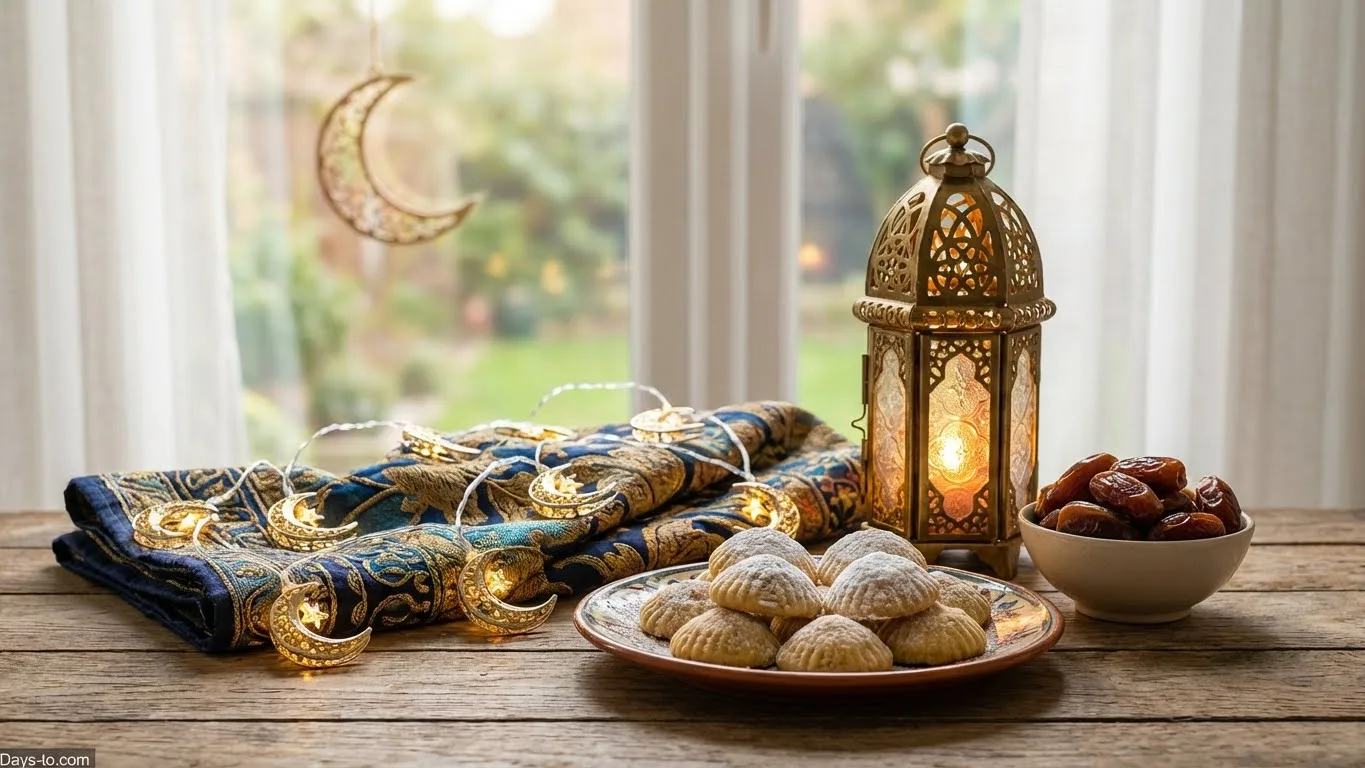
Eid Al Fitr
| Year | Day | Date | Days To |
|---|---|---|---|
| 2027 | Tue | March 9, 2027 | 330 days |
| 2028 | Sat | February 26, 2028 | 684 days |
| 2029 | Wed | February 14, 2029 | 1038 days |
| 2030 | Mon | February 4, 2030 | 1393 days |
| 2031 | Fri | January 24, 2031 | 1747 days |
| 2032 | Wed | January 14, 2032 | 2102 days |
| 2033 | Sun | January 2, 2033 | 2456 days |
| 2033 | Fri | December 23, 2033 | 2811 days |
| 2034 | Tue | December 12, 2034 | 3165 days |
| 2035 | Sat | December 1, 2035 | 3519 days |
The sighting of the new moon marks an important shift in the daily rhythm of millions around the globe. Eid al-Fitr stands as a distinct marker of spiritual accomplishment, concluding the holy month of Ramadan. It is not merely a day of festivity but a profound expression of gratitude to the Creator for the strength to complete the fast. This event, known as the “Festival of Breaking the Fast,” falls on the first day of Shawwal, the tenth month of the Islamic calendar. The atmosphere transforms from the quiet introspection of fasting to an overt display of joy and community togetherness.
Historical Origins and Significance
The origins of this observance trace back to the year 624 CE. It was established by the Prophet Muhammad following the migration from Mecca to Medina. Historical accounts suggest that upon arriving in Medina, the Prophet found the local populace celebrating two specific days with merriment and recreation. He announced that these days were replaced with two better ones: Eid al-Fitr and Eid al-Adha. This historical pivot served to direct the community’s joy towards divine thankfulness rather than mere seasonal traditions.
Unlike many other holidays that celebrate a historical event or the birth of a figure, this occasion celebrates a spiritual achievement. The faithful rejoice in having fulfilled the command of fasting. It represents a spiritual reset, where past minor sins are believed to be forgiven, offering a fresh start. The emphasis is placed heavily on patience and discipline exercised during the preceding month.
Timing and the Lunar Calendar
Determining the exact date of the festival relies strictly on the lunar cycle. Since the Islamic calendar is lunar rather than solar, it creates a unique drifting effect relative to the Gregorian calendar used internationally. The lunar year is approximately 11 days shorter than the solar year. Consequently, the holiday moves backward by about 11 days each year, allowing it to be experienced in every season over a 33-year cycle. The actual day begins only when the crescent moon is confirmed visable by authorized religious bodies.
| Feature | Lunar Calendar (Hijri) | Solar Calendar (Gregorian) |
|---|---|---|
| Basis | Phases of the Moon | Orbit of the Earth around the Sun |
| Year Length | 354 or 355 days | 365 or 366 days |
| Date Consistency | Shifts annually | Fixed dates |
| Determination | Moon sighting | Mathematical calculation |
The Prayer and Zakat al-Fitr
The day commences with a specific communal act known as the Salat al-Eid. This prayer differs from the standard five daily prayers as it has no call to prayer (Adhan) and consists of two units with additional Takbirs (chants glorifying God). It is traditionally performed in large, open areas or major mosques to accommodate vast congregations. Men, women, and children gather shortly after sunrise to participate in this collective act of worship, reinforcing the bond of the Muslim brotherhood.
Before the prayer can be performed, a mandatory charity known as Zakat al-Fitr must be distributed. This is a specific amount of food or its monetary equivalent given to the poor. The primary purpose is to ensure that the less fortunate also have the means to celebrate and do not remain hungry on this day. It purifies the fasting person from any indecent acts or speech committed during Ramadan and serves as a vital socio-economic equalizer within the community.
Culinary Traditions and Social Customs
Fasting is strictly forbidden on this specific day. The consumption of food, particularly something sweet before the prayer, is a documented tradition of the Prophet. This has led to the holiday being nicknamed “Sweet Eid” in various cultures. Households prepare elaborate feasts featuring rich dishes that vary by region. For instance, dates are universally consumed, while specific pastries like Maamoul in the Middle East or Ketupat in Southeast Asia take center stage. These foods symbolize the return to regular sustenance.
Socially, the day involves visiting elders, family, and neighbors. A common greeting exchanged is “Eid Mubarak,” which translates to “Blessed Festival.” It is customary to wear one’s best or new clothes, signifying a renewal of spirit. Gifts, often in the form of money known as Eidi, are given to children, creating a sense of anticipation and happiness. These interactions strengthen kinship ties and help mend past grievances among relatives, prioritizing reconciliation over conflict.