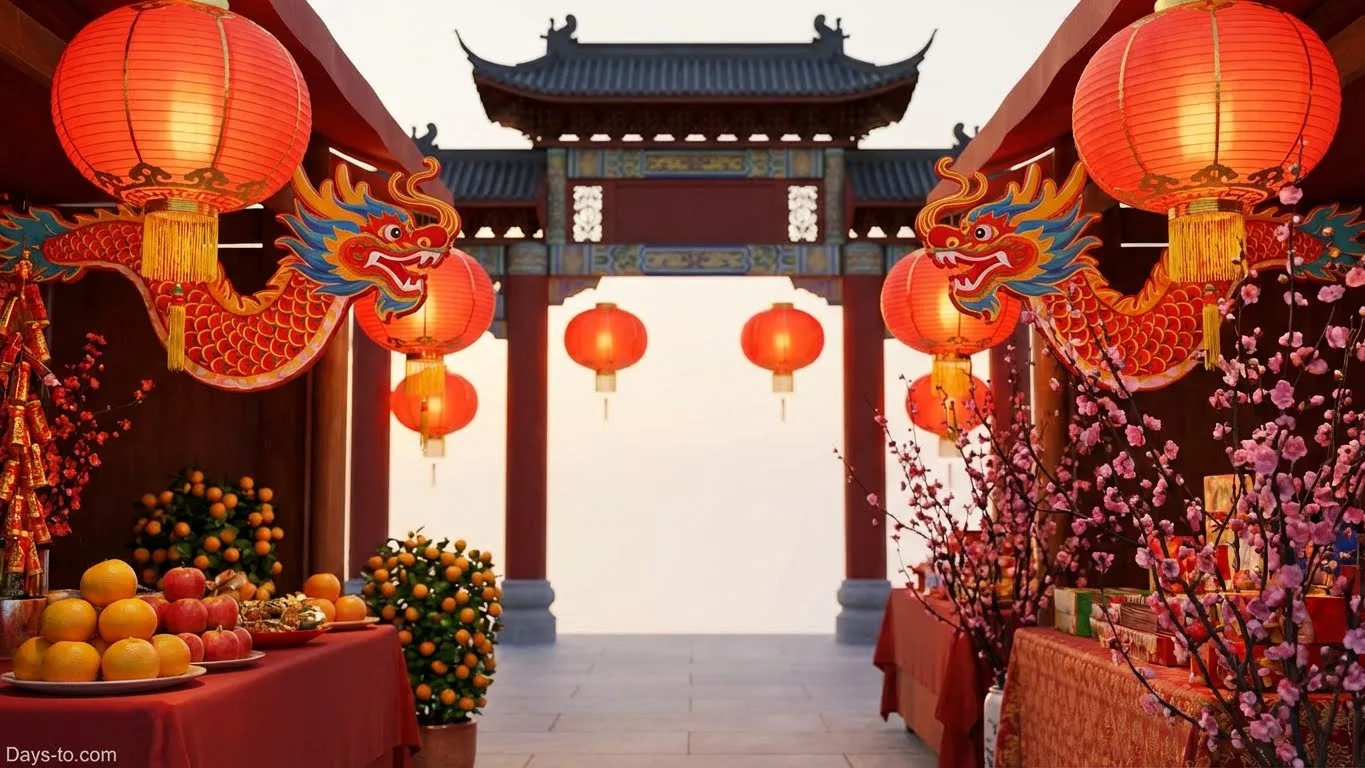
Chinese New Year
| Year | Day | Date | Days To |
|---|---|---|---|
| 2027 | Sat | February 6, 2027 | 299 days |
| 2028 | Wed | January 26, 2028 | 653 days |
| 2029 | Tue | February 13, 2029 | 1037 days |
| 2030 | Sun | February 3, 2030 | 1392 days |
| 2031 | Thu | January 23, 2031 | 1746 days |
| 2032 | Wed | February 11, 2032 | 2130 days |
| 2033 | Mon | January 31, 2033 | 2485 days |
| 2034 | Sun | February 19, 2034 | 2869 days |
| 2035 | Thu | February 8, 2035 | 3223 days |
The arrival of the new moon marks the beginning of the Spring Festival, widely known globally as Chinese New Year. It stands as the most important social and economic event in Chinese culture. This period triggers the largest annual human migration on the planet, as millions return to their ancestral towns to reunite with family. Unlike the Gregorian calendar, this festival follows the lunar cycle, meaning the dates shift annually between January 21 and February 20. It is a time when the old year is cast aside to make space for incoming fortune and prosperity.
The Legend Of The Beast Nian
Ancient folklore drives the specific customs observed today. The narrative centers on a mythical beast called Nian. According to the stories passed down through generations, Nian would arrive on the eve of the new year to devour livestock, crops, and even villagers. People eventually discovered that this fearsome creature feared three specific things: loud noises, bright lights, and the color red. This discovery shaped the modern celebration. Today, families decorate their windows with red paper cutouts and light firecrackers not just for entertainment, but to symbolically keep darkness and misfortune at bay. The atmosphere becomes electric with the sound of explosions and the visual warmth of crimson decorations.
| Year | Lunar Date | Zodiac Animal | Elemental Attribute |
|---|---|---|---|
| 2024 | February 10 | Dragon | Wood |
| 2025 | January 29 | Snake | Wood |
| 2026 | February 17 | Horse | Fire |
| 2027 | February 6 | Goat | Fire |
Rituals Of Cleaning And Decoration
Days before the festivities commence, households undergo a rigorous cleaning process. This tradition is known as “sweeping the dust,” which represents driving away the bad luck of the preceding year. Every corner is scrubbed to ensure the home is ready to receive good luck. Once the cleaning is complete, the decor changes immediately. Doors are adorned with vertical banners called couplets, featuring poetic lines about renewal and spring. The character “Fu” (meaning fortune) is frequently displayed upside down. This is a clever linguistic pun; in Mandarin, the phrase “fortune arrives” sounds identical to “fortune upside down.”
The Importance Of The Reunion Dinner
The New Year’s Eve dinner is the emotional anchor of the entire festival. Family members travel great distances to ensure they are present at this table. The meal is heavy with symbolic meaning. Fish is a mandatory dish because the word for “fish” sounds exactly like the word for surplus. Eating it signifies that the family will have excess wealth and food in the coming year. Another staple is dumplings, particularly in northern China. Their shape resembles ancient silver ingots, implying that the more dumplings you eat, the more wealth you will generate. It is a time of joy, where the struggles of the past are temporarily forgotten in favor of hope and shared abundance.
Red Envelopes And Social Etiquette
Gift-giving during this period has strict rules. The most iconic gift is the Hongbao, or red envelope. Elders give these envelopes containing money to children and unmarried young adults. The significance lies not in the cash inside, but in the red paper itself, which is believed to bestow happiness and protection against evil spirits. Modern technology has evolved this ancient custom; billions of digital red envelopes are now exchanged via smartphone apps like WeChat. However, the rule remains that the amount of money should generally be an even number, as odd numbers are often associated with funerals. It is a delicate balance of generosity and adherence to cultural superstition.
The Lantern Festival Conclusion
The celebrations do not end abruptly. They wind down over a fifteen-day period, culminating in the Lantern Festival. This marks the first full moon of the new lunar year. Streets fill with colorful lanterns, often shaped like animals or spherical globes. A traditional snack called tangyuan—sweet glutinous rice balls filled with sesame or peanut paste—is consumed. The round shape of the bowls and the balls simbolizes family unity and wholeness. It serves as the final act of the Spring Festival, transitioning people back to their daily routines with a renewed sense of purpose and community connection.