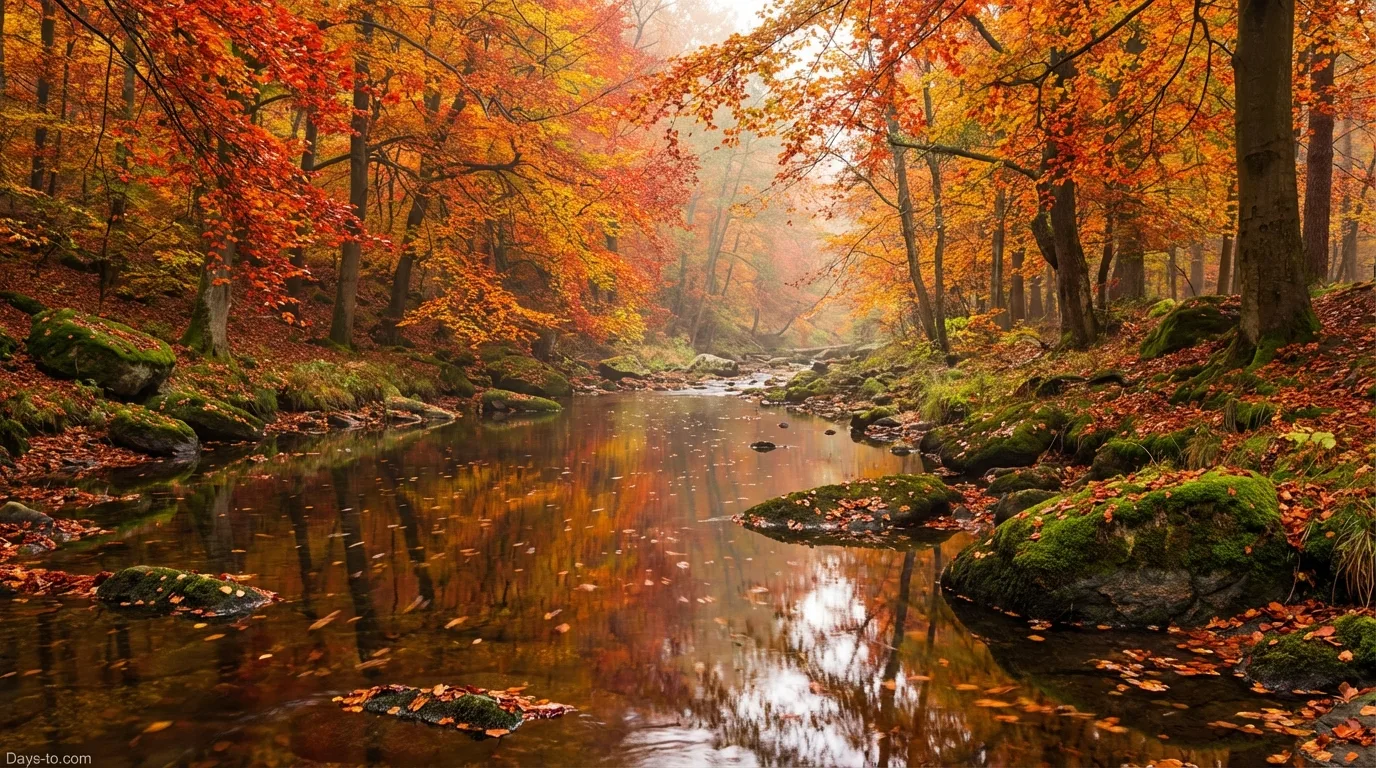
Autumn Equinox
| Year | Day | Date | Days To |
|---|---|---|---|
| 2026 | Wed | September 23, 2026 | 167 days |
| 2027 | Thu | September 23, 2027 | 532 days |
| 2028 | Fri | September 22, 2028 | 897 days |
| 2029 | Sun | September 23, 2029 | 1263 days |
| 2030 | Mon | September 23, 2030 | 1628 days |
| 2031 | Tue | September 23, 2031 | 1993 days |
| 2032 | Wed | September 22, 2032 | 2358 days |
| 2033 | Fri | September 23, 2033 | 2724 days |
| 2034 | Sat | September 23, 2034 | 3089 days |
| 2035 | Sun | September 23, 2035 | 3454 days |
Autumn marks one of the four primary temperate seasons, functioning as the transitional period between summer and winter. This season is immediately noticeable by the shortening of daylight hours and a progressive cooling of temperatures. While often associated purely with falling leaves, the season represents a complex astronomical and biological shift that affects nearly every aspect of the natural world. In many regions, this time is characterized by the harvesting of crops and the preparation of flora and fauna for the coming cold.
The Science of the Equinox
Astronomically, the season begins with the autumnal equinox. This is the precise moment when the Sun crosses the celestial equator, moving from the northern to the southern hemisphere. During this event, day and night are of approximately equal length across the globe. Following this date, the solar energy received by the hemisphere tilts away from the sun, leading to the characteristic drop in thermal energy. This reduction in sunlight is the primary trigger for the biological changes observed in plants and animals.
Why Leaves Change Color
The most visual indicator of the season is the transformation of deciduous foliage. Trees respond to the reduced daylight by ceasing the production of chlorophyll, the pigment responsible for the green color of leaves and photosynthesis. As the green fades, other chemical compounds that were present but masked become visible. Carotenoids produce yellow and orange hues, while anthocyanins are responsible for the vibrant reds and purples. This chemical process allows the tree to reabsorb nutrients from the leaves before they are shed, preserving energy for the winter dormancy.
| Feature | Northern Hemisphere | Southern Hemisphere |
|---|---|---|
| Standard Start | September | March |
| Standard End | November | May |
| Primary Harvest | Corn, Pumpkins, Apples | Grapes, Pears, Citrus |
| Solar Motion | Sun moves South | Sun moves North |
Impact on Agriculture and History
Historically, this period was the most critical time for agrarian societies. The success of the harvest determined a community’s ability to survive the winter. Many ancient calendars were structured entirely around these agricultural cycles rather than arbitrary dates. The Harvest Moon, the full moon closest to the equinox, provides unusually bright moonlight for several consecutive evenings, which allowed farmers to work late into the night gathering crops before the frost arrived. This biological necessity shaped human culture, trade, and social structures for millennia.
Animal Adaptation and Migration
Wildlife exhibits distinct behavioral changes in response to the shifting environment. Many bird species initiate migration patterns, traveling thousands of miles to warmer climates to maintain access to food sources. Non-migratory animals begin the process of hyperphagia, a state of excessive eating to build up fat reserves. Mammals often grow thicker coats of fur to provide insulation against dropping temperatures. Even insects alter their behavior, with some seeking shelter in human structures or burrowing underground to enter a state of dormancy known as diapause.
Weather Patterns and Atmosphere
Meteorologically, the season is defined by increased turbulence in the atmosphere. As the temperature difference between the cooling polar regions and the still-warm equator increases, the jet stream strengthens. This leads to the formation of stronger low-pressure systems and cyclonic storms. In many coastal regions, this period coincides with the peak of hurricane or typhoon seasons due to the stored heat in the oceans releasing into the cooling atmoshpere. Fog becomes more common as cool air settles over warm ground surfaces, creating distinct microclimates in valleys and low-lying areas.